New Dorms Underway at Lehigh University

BETHLEHEM, PA – Bridge West residence hall, a new student living facility under construction on the campus of Lehigh University will, in tandem with the recently renovated University Center, bring new vitality and greater social interaction to the very core of campus.
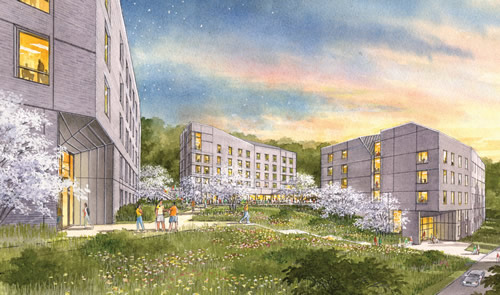
Lehigh University Bridge West

In total, Bridge West will eventually provide housing for 720 students. Its construction, which will develop in two phases, is a key component of Lehigh’s plan to expand its undergraduate student population by approximately 1,000 students. Phase I of the development, which will house more than 400 undergraduate students and include a café, fitness area, kitchenettes, lounge areas, and conference rooms, is expected to open by fall 2020.

Whiting-Turner, which has a Bethlehem office, is building the project. Sasaki Associates of Watertown, MA, designed the project.

Featured

  • A digital silhouette works at a computer, immersed in a glowing, interconnected world

    How Will AI Transform Learning Space Design?

    For years, higher education has designed learning spaces around technology as a tool for display, capture, collaboration, and connectivity. AI changes that equation.

  • Stanford Online Reveals New Immersive Learning Studio

    Stanford Online recently marked its 30th anniversary with the announcement of a new immersive learning studio, according to a university news release. The studio takes advantage of AI-powered and immersive learning technologies to continue delivering personalized and faculty-led education.

  • Cal Poly Humboldt Starts Construction on Healthcare Education Hub

    California State Polytechnic University, Humboldt in Arcata, Calif., recently announced that work has begun on a renovation project that will turn the Stewart Building into a new Healthcare Education Hub, according to a news release. The university is partnering with Sundt Construction Inc. for construction services.

  • Designing for Every Mind

    Learning environments have the power to shape not just what students know, but who they become. When a school is designed with genuine empathy—for the full range of ways students think, sense, and engage with the world—it becomes more than a building. It becomes a catalyst for growth, confidence, and belonging. That is the animating idea behind neurodiverse design, and it is one that is transforming how more architects and designers are thinking about school design.