Wofford College Building Environmental Studies Center

SPARTANBURG, SC – Wofford College has broken ground on its new environmental studies center that will be Green Globe-certified for its sustainable and environmentally conscious features, such as a partial green roof and solar roof panels. Green Globe certification is a structured assessment of the sustainability performance of the facility.
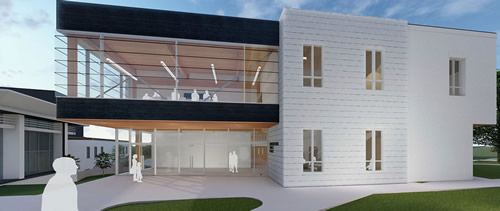
Wofford College Environmental Buidling

The 20,000-square-foot facility will feature advanced laboratory space, a seminar room, outdoor patio and garden spaces, and classroom and office space for Wofford’s Department of Environmental Studies as well as the other sciences.

The building also will include a system for capturing rainwater for irrigation and will use cross-laminated timbers, which are made of sustainable, all-wood construction.

Featured

  • Image courtesy of Kahler Slater

    UW–Madison Announces Completion of Morgridge Hall

    The University of Wisconsin–Madison recently announced that construction is complete on Morgridge Hall, a new academic building, according to a news release. The facility opened September 3 at the start of the fall semester, consolidating the School of Computer, Data & Information Sciences into a single facility for the first time.

  • Northeastern University Breaks Ground on New Housing Community

    Northeastern University recently announced the groundbreaking of a new student housing community on its campus in Boston, Mass., according to a news release. The university is partnering with American Campus Communities (ACC) for development of the project, which will have the capacity for 1,200 students and has a scheduled completion date of fall 2028.

  • Stanford Completes Construction on Graduate School of Education Facility

    Stanford University in Stanford, Calif., recently announced the end of construction on a new home for its Graduate School of Education, according to a news release. The university partnered with McCarthy Building Companies on the 160,000-square-foot project, which involved two major renovations and one new construction effort.

  • Pitzer College

    Designing for Change in Higher Ed Learning Environments

    Higher education will continue to evolve, and learning environments must evolve with it. By prioritizing adaptable infrastructure, thoughtful reuse, strong energy performance, and wellness-centered design, campuses can create spaces that support learning today while remaining flexible for the future.