STEAM Lab Holds Economic Potential for Rural NY Community
- By Yvonne Marquez
- 09/03/19
Groton Junior-Senior High School’s former dingy basement has transformed into a brightly lit $4.8 million STEAM lab and shared-learning space. The 8,000-square foot renovated space officially opens Sept. 4 for district-wide use following a soft-opening in December 2018.
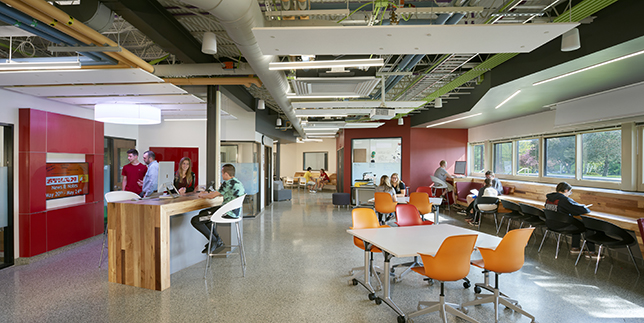
The lounge-like area is fitted with high-tech screens, work stations, adaptable furniture, energy-efficient lighting and HVAC systems. Ashley McGraw Architects designed the center with the district’s curriculum in mind and collaborated with Groton Central School District Superintendent Margo Martin to create a place where students want to hang out.
Almost every surface is a writing surface, including some glass walls, to encourage creativity. The center features transparent and flexible spaces to encourage independent work as well as collaboration. The lab hosts a photo, video, and music editing studio.
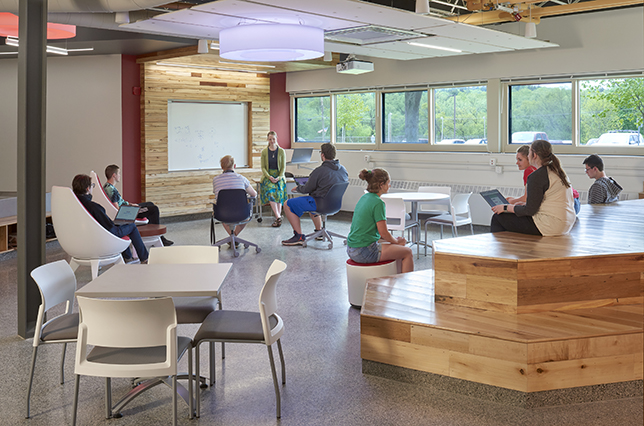
The STEAM lab will be used for a variety of educational programs including: building trades, computer science, engineering & electronics, agriculture technology and communications & media arts.
“Groton CSD STEAM Coordinator Mick Levick has been instrumental in informing the students of the concept of the STEAM lab and giving them the freedom to explore its possibilities,” Mike Frisina, an architect and design tech manager at Ashley McGraw, said in a press release. “Mick has stated that the variety of the spaces and learning environments in the STEAM lab has given the students and the faculty the flexibility to ‘choose your own adventure’ in their educational programs. They have been able to transform the spaces to fit the needs of their tasks on a day-to-day, class-to-class basis.”
The STEAM lab has also had a positive effect on the rural New York community by potentially being an “economic engine.” An agricultural steering committee is promoting the expansion of an agricultural program at the center, while STEAM experts are offering their services as guest speakers and giving adult education courses after school hours.
About the Author
Yvonne Marquez is senior editor of Spaces4Learning. She can be reached at [email protected].