Modern HS with Skylights Upgrades Historic Mass. Town

The new Billerica Memorial High School, in the historic town of Billerica (just north of Boston), recently opened its doors to more than 1,600 students in grades 8 through 12, plus 200 students in their Pre-K program. After a 2012 district-wide master plan identified the need for a new high school, a collaboration between the Massachusetts School Building Authority and the town of Billerica, resulted in a 324,000 square-foot new building that emphasizes a flexible learning environment and serves as a community resource.
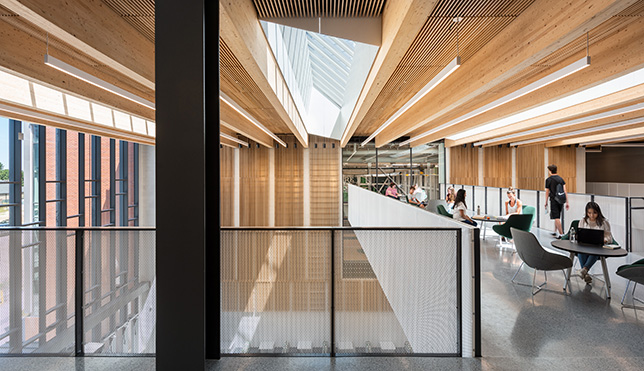
The new Billerica Memorial High School, in the historic town of Billerica (just north of Boston), emphasizes a flexible learning environment and serves as a community resource. Inside, skylights and large windows create an open and bright environment.

The $176 million project was designed by Perkins and Will, constructed by Shawmut Design and Construction and project managed by Leftfield.

The new building is built on the old school site and will include a stadium, turf field, courtyard with an outdoor stage and movie screen, which will be completed by the end of the school year. Inside, skylights and large windows create an open and bright environment.  

Billerica Memorial, designed with community in mind, can accommodate town-wide events in the gym, auditorium and dining commons. Additional site improvements like bike and walking paths and a quad-style civic green will offer lots of spaces for the community to gather.

Perkins and Will incorporated the high school’s past and the town’s history as a New England mill town into their design. They integrated archival photos of the high school, including some of former U.S. President John F. Kennedy visiting the school as a senator, into the interior design. They opted for traditional building materials while also adding a modern touch.

“At every scale, we used simple, honest materials — wood, brick, steel — in thoughtful, inventive compositions. In that way, we marry the architectural grammar with the community’s story,” Patrick Cunningham, designer at Perkins and Will, said in a press release.

About the Author

Yvonne Marquez is senior editor of Spaces4Learning. She can be reached at [email protected].

Featured

  • Embry-Riddle Completes Construction on Research, Lab Facility

    Embry-Riddle Aeronautical University (ERAU) in Daytona Beach, Fla., recently announced the end of construction on a new research and lab facility on campus. The Center for Aerospace Engineering II (CAT II) will support aerospace research and technology development and broke ground last summer.

  • Designing the Bridge Between Inclusivity and Independence in K–12 Schools

    Fostering independence is fundamental to learning and development for K–12 students. It offers many proven benefits, such as enhanced confidence, problem-solving, decision-making, and social skills. However, this foundational objective loses its impact if it’s not accessible and adaptable to all students. Inclusivity plays a critical role in cultivating independence and healthy autonomy for students, fostering positive student learning outcomes by uniting pedagogy with the physical learning environment.

  • Year-Round Schools Require Year-Round Indoor Air Quality Planning

    While many schools are out for the summer, year-round schools follow a more “balanced” schedule with shorter, more frequent breaks spaced throughout the school year. Even though this offers educational benefits, these facilities have less downtime for building maintenance. This can become an issue when facilities managers overlook the importance of routine HVAC maintenance and air duct cleaning services.

  • Planning with Clarity: Using AI to Make Better Campus Decisions, Not Just Better Designs

    Higher education leaders are being asked to make increasingly high-stakes decisions about campus facilities amid greater uncertainty than ever before. Social and economic pressures, shifting enrollment, and evolving learning models compete with growing deferred maintenance needs to strain even the most robust infrastructure budgets.