Fairfield University Unveils New Convocation Center

CENTERBROOK, CT – Fairfield University has unveiled a new multipurpose on-campus arena called the Convocation Center, designed by Centerbrook Architects & Planners.

The 3,500-seat facility will serve as the home for the Fairfield basketball and volleyball teams, as well as host concerts, commencements, and other larger on-campus events.
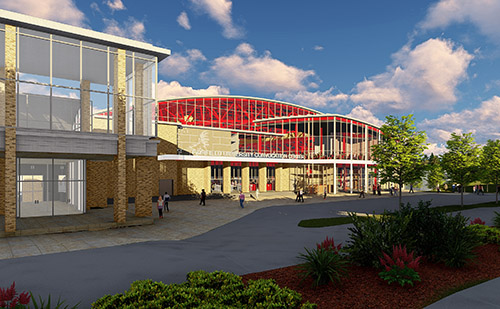
Fairfield University Convocation Center 500

The lower bowl is designed to seat approximately 2,400. A second deck will hold around 1,100, highlighted by The Stag Club, which offers premium seating and hospitality for 150. The design provides unobstructed views from the concourse on both levels. Its 85,000-square-feet also houses locker rooms, a film room, lounge, training rooms, staff offices, and numerous support spaces.

Designed to be modern yet contextual, the estimated $45-million Convocation Center will provide a dramatic arrival with a transparent front entrance that reveals the building’s interior. Natural light enters from three sides of the arena through ample glass that complements the brick façade, which blends with the campus palate. The curved roof is a nod to the current Alumni Hall and many mid-century arenas.

The Convocation Center will replace the 2,500-seat Alumni Hall, which has played host to Fairfield athletics and campus events since 1959. Following its demolition, construction of the new facility is projected to commence in the spring of 2020 and span 18-24 months.


Featured

  • Fargo, N.D., Starts Construction on Consolidated Elementary School

    Fargo Public Schools in Fargo, N.D., recently announced the beginning of construction on a new elementary school, according to a news release. The district partnered with ICON Architectural Group and Kraus-Anderson Construction on the new Horace Mann Elementary School.

  • abstract illustration of school gym

    How the Gymnasium Can Serve as a Model for Learning Space Design

    Multipurpose gyms work because flexibility was built into the brief from the start, not retrofitted later. The same logic applies to academic spaces.

  • Doerr School of Sustainability Accelerator

    From Concrete Warehouse to Innovation Hub: Accelerating Sustainability at Stanford

    The transformation of a once windowless, concrete publishing warehouse into a sun-drenched center for global innovation began with a single, fundamental challenge: how to turn an industrial storage shell into a space built for human connection.

  • Can AI Help Build Stronger Communities in Student Housing?

    Student housing success is shifting from operational performance to student experience, with belonging now at the center. A recent 2025 report underscores a growing emphasis on student well-being, community, and engagement, signaling that expectations now extend beyond logistics to ensure students feel supported in their living environments. AI is enabling that shift by reducing administrative workload and giving teams more time to focus on meaningful student engagement.