State-of-the-Art Health Sciences Building Underway at Assumption College

WORCESTER, MA – Construction has begun on a new 41,000-square-foot Health Sciences Building at Assumption College. A groundbreaking was held on May 10 and construction will be completed for the fall 2020 semester. The facility was designed by Nault Architects, Lauring Construction is serving as general contractor on the project.
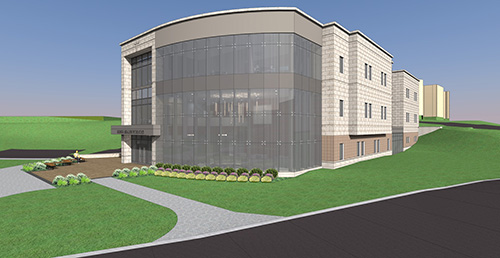
Assumption College Health Sciences Building

The Health Sciences building will house the nursing and physician assistant studies programs set to open in fall 2020, but will benefit students in all disciplines. The nursing floor will feature a large nursing skills lab with seven full-sized hospital beds for teaching patient care. Four simulation labs will have hi-fidelity manikins which can simulate actual patient conditions (vitals, seizures, cardiac arrest, childbirth, etc.) ,all of which can be controlled remotely by a simulation lab technician.

Throughout the spacious building with an interior illuminated by natural light, students will have access to lounges, smaller break-out space and de-briefing rooms and conference rooms, nine offices for faculty and staff, and suites for each of the deans.

Featured

  • Embry-Riddle Completes Construction on Research, Lab Facility

    Embry-Riddle Aeronautical University (ERAU) in Daytona Beach, Fla., recently announced the end of construction on a new research and lab facility on campus. The Center for Aerospace Engineering II (CAT II) will support aerospace research and technology development and broke ground last summer.

  • Dallas ISD Voters Approve $6.2B Bond Package

    Dallas ISD voters have approved a record-setting $6.2-billion bond package that district leaders say will modernize aging campuses, eliminate portable classrooms and reshape learning environments across one of the nation’s largest school systems.

  • UCF Modernizes College of Hospitality Management

    The University of Central Florida in Orlando, Fla., recently completed a major renovation effort for the Rosen College of Hospitality Management, according to a news release. The project modernized 77,600 square feet worth of academic classrooms, teaching labs, and collaborative spaces to support both students and faculty.

  • Rethinking K-12 Schools as a Continuous Learning Experience

    Most students move through three or more separate facilities during their K-12 journey, yet the built environments they encounter at each stage have traditionally been designed in isolation, with little continuity in spatial language, learning philosophy, or physical resources. Each new school is a reset with different layouts, learning models, expectations, and ways of moving through a building. The next generation of school design is making the case that the first day of kindergarten and the last day of high school can and should feel connected through common support systems and infrastructure in the physical environment.