Edward J. Minskoff Pavilion at Michigan State University Completed

EAST LANSING, MI – LMN Architects celebrated the opening of the new Edward J. Minskoff Pavilion at Michigan State University on September 27. The building combines state-of-the-art teaching facilities with social spaces and establishes a new front door for the Broad College of Business.
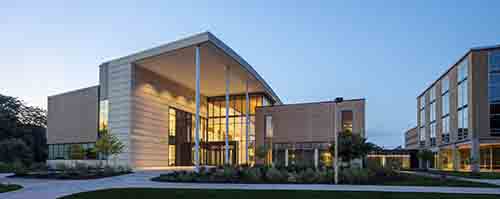
Michigan State Minskoff Pavilion 500 

Photo © Adam Hunter.LMN Architects

The Edward J. Minskoff Pavilion at Michigan State University transforms the Eli Broad College of Business into a unified complex at the forefront of business education. The three-story, 100,000-square-foot structure combines modern teaching facilities with contemporary social spaces, creating a socially active learning environment for students, faculty, corporate partners, and alumni to collaborate in forming future generations of business leaders. Technology integration, classrooms, and flexible spaces promote academic and professional excellence, uniquely suited to problem solving in today’s global marketplace.

Located within the heart of the university along the Red Cedar River, the massing and geometry of the building complete the sequence of spaces in the college’s existing facilities while creating a new connection to the river walk. A riparian meadow is designed to both manage storm water and reestablish a natural habitat along the Red Cedar River.

Inspired by Broad College’s team-based community culture, the design weaves together classrooms, team rooms, and social spaces at a variety of scales. These program elements permeate all aspects of the academic experience, with an emphasis on collaborative environments supporting the college’s cutting-edge research curriculum.

Featured

  • Benson Polytechnic High School in Portland, OR

    Preserving Legacy, Designing for the Future

    As historic academic buildings age, institutions face a difficult decision: preserve and adapt or demolish and rebuild. How do we honor the legacy of these spaces while adapting them to meet the needs of modern learners?

  • UNL Kiewit Hall

    Designing for Engineering Excellence: Integrating Sustainability and Wellness at UNLs Kiewit Hall

    Kiewit Hall at the University of Nebraska-Lincoln exemplifies how academic institutions can integrate sustainability and wellness into modern learning environments. With an integrated and collaborative team approach, Kiewit Hall addresses enhanced learning and creativity, physical health, and mental wellness, and fosters a sense of community through innovative design, operations, and policy solutions.

  • Different Starting Points, Same End Goal

    Higher education campuses can enhance student experience by implementing mobile credentials to streamline building access, on-campus payments, and access to other amenities. This enables students to connect to their campuses through the technology they use most: their mobile devices.

  • Illinois State University Breaks Ground on College of Fine Arts Transformation

    Illinois State University in Normal, Ill., recently held a groundbreaking ceremony for the Wonsook Kim College of Fine Arts transformation project, according to university news. The series of new constructions and renovations will upgrade spaces in Centennial East, the Center for the Visual Arts, and the Center for the Performing Arts, as well as replace the existing Centennial West facility with a new Commons Building.

Digital Edition