Rolling Privacy Panels Facilitate Physical Distancing
- By Dian Schaffhauser
- 07/14/20
A manufacturer of block windows has developed a line of rolling privacy panels. U.S.-based Hy-Lite said its new panels are made of architectural-grade acrylic blocks that allow light through while protecting privacy.
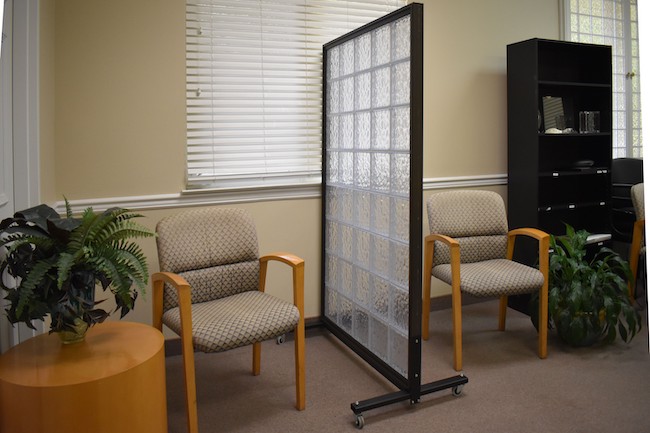
Each block is eight inches by eight inches and one and a half inches thick, with an air gap in the center. They're secured in place by a white or bronze vinyl frame and come in three styles: "wave," "glacier" or "cross rib." The panel of blocks is secured to a welded metal black base, with a set of four two-inch casters, each with a locking mechanism to keep the panel in place once it's moved where it's needed. The panels can also be made without the casters for use as permanent or semi-permanent barriers.
According to the company, the walls can be sanitized with bleach, hydrogen peroxide (up to 40 percent), soap and water, or isopropyl alcohol (up to 30 percent). "This means that these rolling panels can be cleaned and reused over and over to provide a safe, sanitized barrier from germs," said Steve Beck, plant/technical manager with Hy-Lite, in a press release.
Sizes range from 42 to 58 inches in width, and from 71.5 to 79.5 inches in height. Pricing starts at $659 per panel and includes free shipping. Customers that order 10 or more panels get a 10 percent discount.
Learn more on the Hy-Lite website.
About the Author
Dian Schaffhauser is a former senior contributing editor for 1105 Media's education publications THE Journal, Campus Technology and Spaces4Learning.