Cleaning Robot Pitched for Classrooms

Imagine a Roomba with a plastic pillar on top, roaming through a room dispensing disinfectant onto chairs, table-tops and other surfaces. That's the latest product from CIRQ+, a start-up that launched by producing a room cleaning system for the hospitality segment. Now the company has turned its attention to classrooms with the release of the CIRQ+ Clean.
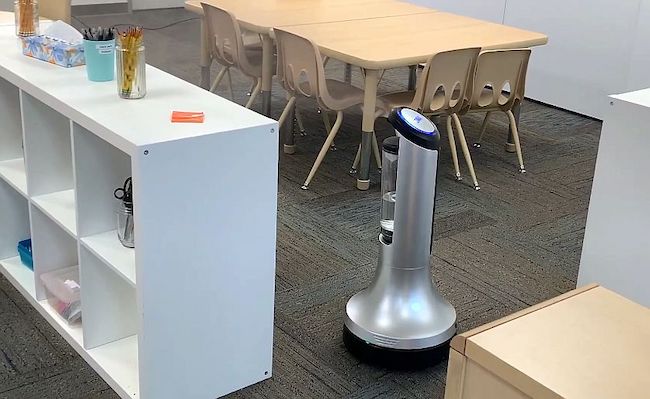
As it moves throughout the room, the cbot sprays a cleaning agent that, according to the company, is effective against SARS CoV-2, the novel coronavirus that generates COVID-19, as well as other pathogens.

Described as a smart "cbot," or cleaning robot, the unit is controlled by an in-room hub. As it moves throughout the room, the cbot sprays a cleaning agent that, according to the company, is effective against SARS CoV-2, the novel coronavirus that generates COVID-19, as well as other pathogens.

In a video about the system, the company said the chemical used was "EPA-registered and CDC-approved"; safe for use around adults, children and pets; and safe on fabrics, clothing and other materials.

About the Author

Dian Schaffhauser is a former senior contributing editor for 1105 Media's education publications THE Journal, Campus Technology and Spaces4Learning.

Featured

  • Philadelphia Middle School Facility Earns LEED Gold Certification

    The Alternative Middle Years (AMY) at James Martin Middle School in Philadelphia, Penn., recently received a LEED Gold certification from the U.S. Green Building Council, according to a news release. The School District of Pennsylvania partnered with KSS Architects on the project.

  • GeoCam and UCLA: Modernizing Campus Accessibility Mapping

    In early 2025, UCLA partnered with GeoCam to capture and modernize its pedestrian infrastructure data. The goal was ambitious but clear: to produce a high-accuracy, imagery-backed digital map of every sidewalk, pathway, ramp, and ADA-related feature on UCLA’s 419-acre campus.

  • Johns Hopkins Starts Construction on New Residence Hall, Dining Facility

    The Homewood Campus of Johns Hopkins University in Baltimore, Md., recently began construction on a new residence hall and dining facility, according to university news. The work involves demolishing the existing Alumni Memorial Residence Hall I, which was built in 1923, to make room for the new facility.

  • Building Beyond Simulation: Creating Immersive Ecosystems for Healthcare Education

    Health sciences education is one of the fastest-growing facility types in colleges and universities. The demand for medical, nursing, and allied health professionals is driving the creation and renovation of medical simulation training facilities that provide students with real-world experience through advanced simulation-based learning.