With New Open-Air Classrooms, Nashville Private School Moves Learning Outdoors
- By Yvonne Marquez
- 11/06/20
While COVID-19 safety was top of mind for faculty at Linden Waldorf School in Nashville, Tennessee, it wasn’t the school’s motivating factor to construct eight outdoor learning pavilions on their 12-acre campus.
The private school prioritizes an outdoor curriculum with two recesses a day and classes like gardening, orienteering, and botany. With a curriculum centered on connection to nature and environmental stewardship, the vision for the pavilions were to move all classes completely outdoors where students get to be in nature throughout the whole school day.
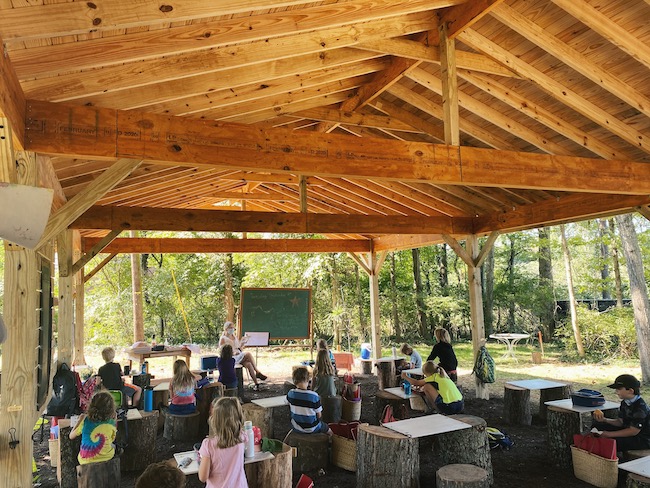
“When it came to allocating our resources to adapt to this school year, we could have spent money on technology for virtual school — for instance laptops, cameras, and tablets,” Tricia Drake, Head of School at Linden Waldorf School, said. “But we instead chose to invest in the pavilions to support outdoor, in-person learning. Our outdoor classrooms are truly emblematic of who we are and what we value.”
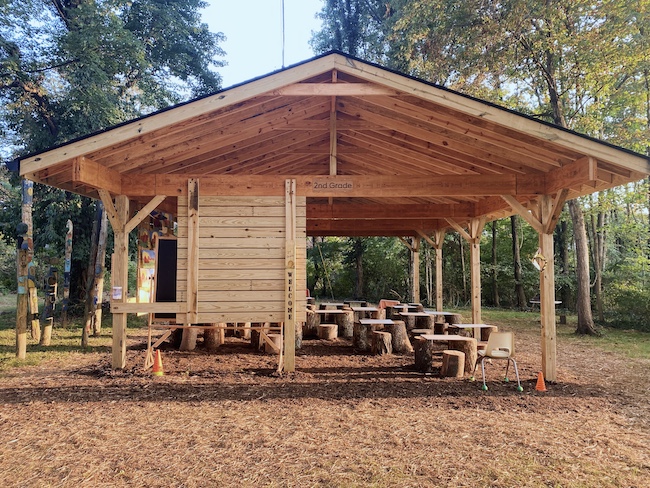
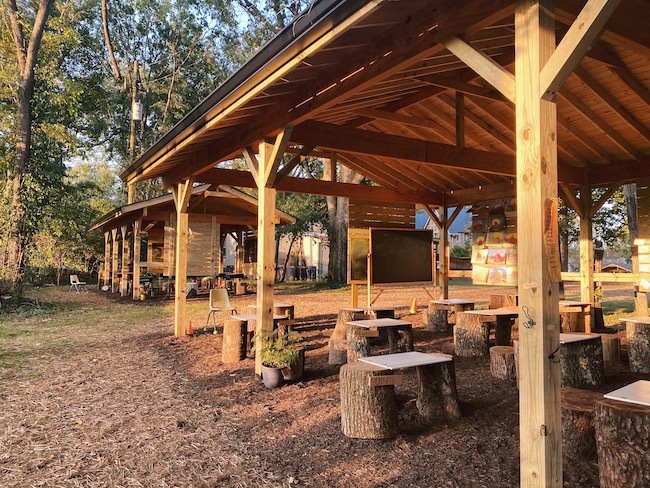
Designed and developed by The Bradley Projects, the eight structures have roofs and partitions to block the reflection of the sun and provide open-air classrooms for the school’s 120 pre-K through 8th grade students. Each structure is about 800 square feet and have tree stump chairs, mulch flooring, hand-cleansing stations and nearby portable sinks. The pavilions were designed and constructed within four weeks.
One of the CDC’s recommendations for maintaining healthy school environments during the COVID-19 pandemic is to increase outdoor air ventilation. “Bringing fresh outdoor air into a room can dilute and/or displace any present airborne virus, which thus reduces the probability that someone breathes enough infectious aerosol to become infected,” a Harvard report on risk reduction strategies for reopening schools says. With these guidelines in mind, having outdoor classrooms, like the ones constructed at the Waldorf school, is ideal for in-person learning.
Jared Bradley, president and founder of The Bradley Projects, calls the pavilions “a permanent solution for a temporary problem.” Although the pavilions are a creative solution to combat the COVID-19 pandemic, the pavilions are meant to be used in “perpetuity,” Bradley says.
“We focused really hard on the fact that COVID isn't going to be around forever,” he explains. “And so, what happens when COVID's gone? Let's make sure that we're doing some smart space planning and master planning for the functions of the school and its entirety.”
For example, the school can now use the pavilions for their annual fall festival, The Elves Faire. The school usually sets up pop-up tents on the campus with games and activities like archery and candle-dipping but now the school has permanent outdoor spaces for these activities.
Bradley’s three children are enrolled at Linden Waldorf School so he was deeply familiar with the school’s core values. He wanted the project to “embody the spirit of the curriculum” and to complement the surrounding campus landscape.
“The inside of the structures — up in the ceiling to make it much more natural — we used a tongue and groove wood ceiling system that's both structural and beautiful to look at when you look up,” he said. “You see all the beautiful wood structures that kids can really look at it in terms of geometry, physics, and statics.”
Instead of using outdoor furniture, the open-air classrooms are outfitted with tree stumps made of a few old, decaying trees that were cleared in order to construct the pavilions. “We wanted to show the kids how you can reclaim, recycle, and reuse things of the Earth and make them very usable here,” Bradley says.
The outdoor classrooms were completed in time for the start of the Fall semester. Teachers and students are loving the pavilions and being outside, Drake said. There has been a noticeable shift in student’s behavior, Drake noted.
“Fresh air, sunshine, laughter, lots of physical activity, and time with your friends are proven to reduce stress and our students get plenty of this on a daily basis,” Drake said. “Academically and intellectually, they’re more focused and more engaged with the curriculum and we’ve seen a sharp drop in behavioral and disciplinary incidents now that we are outside in the pavilions all day.”
About the Author
Yvonne Marquez is senior editor of Spaces4Learning. She can be reached at [email protected].