U Toledo Developing Solar Sheets to Generate Power in Space
- By Dian Schaffhauser
- 02/26/21
The University of Toledo just received a five-year, $12.5 million grant from the U.S. Air Force to develop flexible solar cell sheets for space. The photovoltaic energy sheets will be used to collect solar energy for powering Earth-based receivers or other orbital or aerial instrumentation, such as communications satellites.
Physicists at the institution will develop flexible solar cell sheets, each about the size of a piece of paper, which can be assembled and connected into considerably larger structures. A single space-based array could use tens of millions of the sheets and extend to sizes as large as a square mile. (U Toledo won't be engineering the arrays, however.) An array of that size is projected to be able to generate about 800 megawatts of electrical power, enough to power about 130,000 houses on earth for the day.
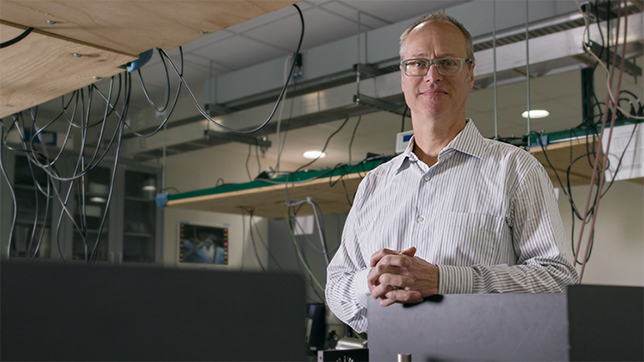
Randall Ellingson, a professor of physics, received a $12.5 million grant from the U.S. Air Force to develop space-based solar energy sheets for transmitting clean power back to Earth or satellites in orbit.
Source: University of Toledo
The researchers are building tandem solar cells—two cells stacked on top of each other that are more efficient for harvesting the sun's spectrum—on ultra-thin, flexible supporting materials. The team will "sandwich" various groupings of solar cells, including perovskites, silicon, cadmium telluride and copper indium gallium selenide, to see what the optimal combination is. The team will also investigate the use of lightweight, flexible supporting material—thin ceramic, plastics and glass—to create the large solar cell sheets. According to the physicists, those materials need to be "resilient, ultra-thin and tolerant to high and low temperatures."
"With 37% stronger sunlight above the atmosphere than on a typical sunny day here on Earth's surface, orbital solar arrays offer a critical opportunity to harness renewable energy, achieve sustainability goals and provide strategic power for a wide range of orbital and airborne technologies," said Randall Ellingson, a professor in the university's Department of Physics and Astronomy, member of the school's Wright Center for Photovoltaics Innovation and Commercialization and leader of the project, in a statement.
This isn't the first time Ellingson has worked with the Air Force on space projects. In 2019, his team received $7.4 million to develop solar technology to power space vehicles using sunlight.
About the Author
Dian Schaffhauser is a former senior contributing editor for 1105 Media's education publications THE Journal, Campus Technology and Spaces4Learning.