Specialty Contractors Waterproof University Boathouse Practice Tank

Two Minneapolis contracting firms recently partnered to make some long-needed repairs to the University of Minnesota’s on-campus boathouse.

The university’s Irene Claudia Kroll Boathouse is located on the shore of the Mississippi River and is one of a very small number of on-campus boathouses in the U.S. The facility features an erg room, a locker room, coaches’ offices, boat storage, and a 7,500-gallon indoor practice tank on the second floor.
University of Minnesota boathouse

The structure was built in 2007, and over time, water that splashed or leaked out of the practice tank had begun seeping through the flooring into the first floor. The facility was originally built with a nonstructural topping slab and precast flooring planks.

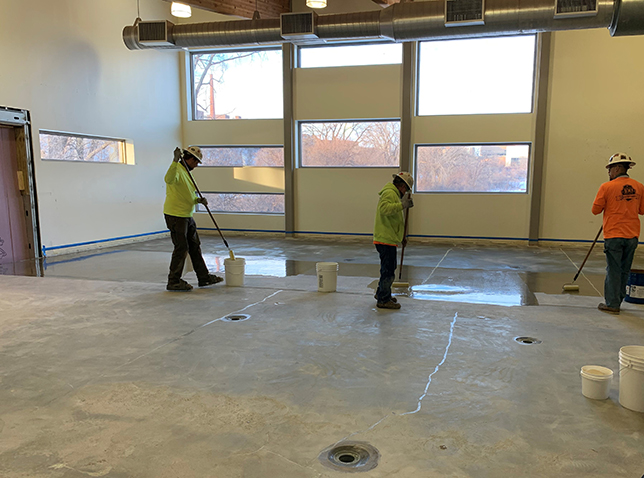
Western Specialty Contractors – Minneapolis Branch and the Minnesota-based general contractor Gardner Builders teamed up for the repair process, which started in Nov. 2020 and finished this month. Gardner Builders removed the tank and installed a drainage system. Then, the Western Specialty Contractors crew repaired the concrete surrounding the new drains and other cracks in the topping slab.

Before the new tank was finally installed, Western applied a 125-mil Tremco PUMA waterproof coating system to the surrounding concrete floor as a last layer of protection. “The waterproofing is a very heavy-duty and durable system that comes with a 20-year warranty but will actually last much longer than that,” said David Grandbois, Assistant Branch Manager of WSC – Minneapolis. “To ensure that the floor was monolithic and free from variances, Western performed an electronic leak detection test on the floor, which found no discrepancies.”

Due to the pandemic, the facility has been closed, so there were no schedule conflicts between the construction team and the university rowing team.

About the Author

Matt Jones is senior editor of Spaces4Learning. He can be reached at [email protected].

Featured

  • Rethinking K-12 Schools as a Continuous Learning Experience

    Most students move through three or more separate facilities during their K-12 journey, yet the built environments they encounter at each stage have traditionally been designed in isolation, with little continuity in spatial language, learning philosophy, or physical resources. Each new school is a reset with different layouts, learning models, expectations, and ways of moving through a building. The next generation of school design is making the case that the first day of kindergarten and the last day of high school can and should feel connected through common support systems and infrastructure in the physical environment.

  • Planning with Clarity: Using AI to Make Better Campus Decisions, Not Just Better Designs

    Higher education leaders are being asked to make increasingly high-stakes decisions about campus facilities amid greater uncertainty than ever before. Social and economic pressures, shifting enrollment, and evolving learning models compete with growing deferred maintenance needs to strain even the most robust infrastructure budgets.

  • Virginia Tech Tops Out New College of Engineering Building

    Virginia Tech in Blacksburg, Va., recently celebrated the topping out of Mitchell Hall, which will soon stand as the largest College of Engineering building on campus, according to a news release. The university partnered with Skanska on the 285,500-square-foot facility, which has an expected completion date of winter 2028.

  • Children walking along bright school corridor with motion blur

    How Next-Gen Design Is Reshaping the Student Experience

    The environments where students learn play a crucial role in shaping their growth in and out of the classroom. By centering design on well-being, flexibility, and purpose, districts can ensure their facilities remain vibrant community assets for many years to come.