Safeguard Schools Against COVID-19 Efficiently via Energy Recovery Ventilation
Achieving healthy and safe schools is more critical than ever in the new pandemic normal.
Increased Building Ventilation
Counters COVID-19 in Schools
Even before the novel coronavirus pandemic, indoor air quality
(IAQ) was considered to be important for supporting occupant
health. In fact, the EPA found that indoor air is typically two to
five times (and occasionally as much as 100 times) more polluted
than outdoor air. Consequently, the EPA ranks indoor air pollution
as a top-five environmental risk to public health.
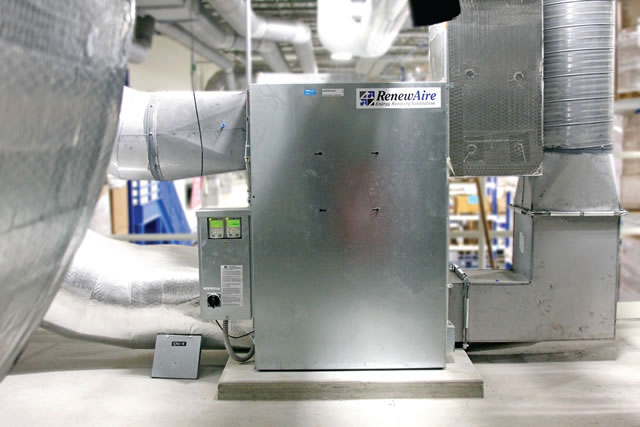
Source: RenewAire.
Figure 1: ERVs recovery otherwise-expended total energy
(heat and humidity) to condition incoming outdoor air
in the ventilation process This safeguards schools against
COVID-19 and optimizes energy efifficiency.
Now, in the COVID-19 era, high-level IAQ is even more
imperative. That’s because experts agree that one of the principal
transmission routes of SARS-CoV-2 (the virus that causes
COVID-19) is through the air. The real problem arises in the
small, virus-laden aerosols that can stay airborne for hours and
travel considerable distances indoors. Increased building ventilation
is vital for reducing the threat of COVID-19.
In fact, the more ventilation the better, because it removes
harmful indoor air contaminants such as SARS-CoV-2. Further,
the higher the percentage of outdoor air coming indoors, the
lower the spread. K-12 and higher-education institutions are
particularly vulnerable to COVID-19 because they house many
people. Thus, increased building ventilation is even more crucial
in institutions of learning in the COVID-19 era.
However, more ventilation (notably with higher percentages
of outdoor air) means extra HVAC energy consumed. It also
necessitates additional HVAC equipment. All of this adds up to
expanded costs. This conundrum creates the challenge all buildings
face: How can schools combat the virus while minimizing
energy consumption and costs?
Boost Ventilation Rates Efficiently
With Energy Recovery Ventilation
The answer is utilizing energy recovery ventilation, which
achieves the needed ventilation while using minimal energy. The
systems that employ this technology are called Energy Recovery
Ventilators (ERVs), and here’s how they work:
- ERVs use balanced airflows to replace equal parts of stale
indoor air with fresh and filtered outdoor air.
- They recover otherwise-expended total energy comprising heat
(sensible) and humidity (latent). This waste energy is reused to
condition the outdoor air coming inside.
- Subsequently, less energy is needed for conditioning and
ventilation, which means HVAC equipment can be downsized.
- Indoor air contaminants like SARS-CoV-2 are exhausted out.
Also, energy efficiency is optimized and costs are decreased.
ERVs can be used in every type of structure in both retrofits and
new construction to tackle COVID-19. The systems excel in K-12
schools, higher-education institutions and buildings and homes
of every size and geography. Further, ERVs can be easily installed
into existing HVAC infrastructure due to tremendous flexibility.
The Results for Schools: Mitigate
COVID-19 and Maximize Energy Savings
ERVs provide effective and energy-efficient ventilation,
thus making them indispensable in stopping the spread of
COVID-19. This is especially true for K-12 and higher-education
institutions due their high occupancy and greater risk
of virus transmission. Installing ERVs in schools leads to the
following results:
- Mitigate COVID-19 and enhance IAQ energy-efficiently:
ERVs are the only solution to marry increased ventilation rates
with lower energy costs. This enhances IAQ, exhausts airborne
virus particles and cuts energy use and costs.
- Safeguard schools against COVID-19: By employing increased
building ventilation effectively and efficiently, schools will be
healthier and safer for students, teachers and staff alike.
- Reduce ventilation energy costs up to 65%: Reusing otherwise-expended total energy significantly lessens energy costs.
- Achieve higher building codes and standards: To ensure the
health of indoor occupants, higher building codes and standards
are required. ERVs are mandated by the most stringent
ones to improve IAQ and energy savings.
For more information on why increased building ventilation
is key for countering COVID-19 in schools, visit: www.renewaire.com/schools.
This article originally appeared in the Spring 2021 issue of Spaces4Learning.
About the Author
Nick Agopian is Vice President, Sales and Marketing at RenewAire, a pioneer in enhancing IAQ via energy recovery ventilation.