Kent State Board Approves College of Aeronautics and Engineering Building Addition

During its quarterly meeting last week, the Kent State University Board of Trustees approved an addition to the university’s Aeronautics and Engineering Building. The College of Aeronautics and Engineering opened in spring 2015, and since then, enrollment has grown enough to require additional space for faculty research and student classes and labs.

According to a press release, the building’s three-story addition will measure in at 41,449 gross square feet and feature classrooms, instructional and research laboratories, active teaching classrooms, cyber classrooms, networking labs, and faculty offices.
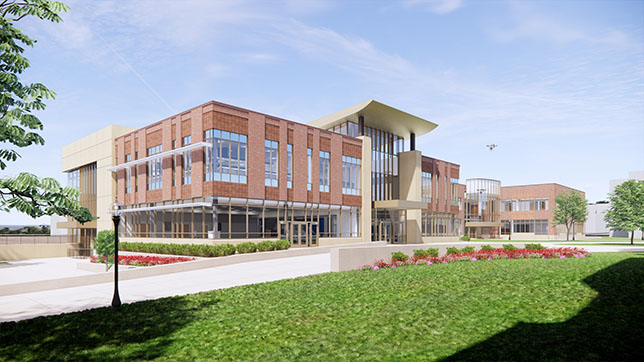
Kent State College of Aeronautics and Engineering addition

Design and construction documents are scheduled for completion by August. After bidding and contract negotiations, groundbreaking should take place in October 2021 for a 14-month construction process. The new facility would open to faculty and students in time for the spring 2023 semester.

The project’s estimated price tag is $19.6 million. Of this, $14.1 million is slated to come from 2020 bond proceeds, $4 million from local funds, and $1.5 million from philanthropic gifts to the university.

A press release states that enrollment in Kent State University’s College of Aeronautics and Engineering has increased by 52 percent since 2019 and by 7 percent since 2020, despite the coronavirus pandemic. A gap between the available workforce and industry needs sets up a wide variety of opportunities for new graduates.

About the Author

Matt Jones is senior editor of Spaces4Learning. He can be reached at [email protected].

Featured

  • University of Tennessee at Chattanooga Launches New Emergency Communications System

    The University of Tennessee at Chattanooga (UTC) recently deployed a new emergency notification and incident management system for its campus, according to a news release. The university partnered with 911Cellular to launch Safe@UTC, a smartphone app allowing university officials to communicate and respond during emergency situations.

  • Spaces4Learning Trends & Predictions for Educational Facilities in 2026: Part II

    As education leaders look toward 2026, the design of K–12 and higher education facilities is being reshaped by powerful, converging forces. Survey respondents point to the rapid growth of Career and Technical Education, deeper alignment with workforce and industry needs, and the accelerating influence of AI and emerging technologies.

  • University of Arizona Approves New Residence Hall

    The Arizona Board of Regents recently approved plans for a new residence hall at the University of Arizona in Tucson, Ariz., according to a news release. The new facility is scheduled to open in fall 2028 and have the capacity for more than 1,200 students, enforcing a new university expectation that all first-year students live on campus.

  • How a Portable Sink Helped an Art Classroom Run More Smoothly

    Classroom design decisions can have outsized effects on instructional time and safety at schools juggling mismatched infrastructure, strict budgets, and crowded schedules — particularly in the arts. Between spilled paint and dirty brushes, art classes run smoother with a sink in the studio. But many schools don’t have a sink in every art classroom.