Mohawk Group Expands Popular Carpeting Collection
Flooring solutions company Mohawk Group recently announced that it is expanding its Learn & Live Collection with the addition of Taking Steps, made up of three versatile 24” x 24” modular carpet styles.
According to a news release, Taking Steps offers a variety of worry-free solutions to educational clients. The product is maintenance-friendly and offers long-term performance through its Duracolor Tricor premium nylon and EcoFlex NXT backing. The product is also easy to install and simple to use, offering three distinct patterns and scales.
“Learn & Live draws its inspiration from cues found within a fascinating design study around biophilic concepts of complexity and order,” said Jackie Dettmar, Mohawk Group’s vice president of marketing, design and product development, in a news release. “The research links the incorporation of these ideas into the built environment to increased collaboration, creativity and social interaction, as well as a reduction of negative behavior. Using this concept as the basis for inspiring learning spaces, Learn & Live can enhance the learning experience. Taking Steps speaks to the issues that school specifiers—whether they are design professionals or school facilities personnel—are most concerned about.”
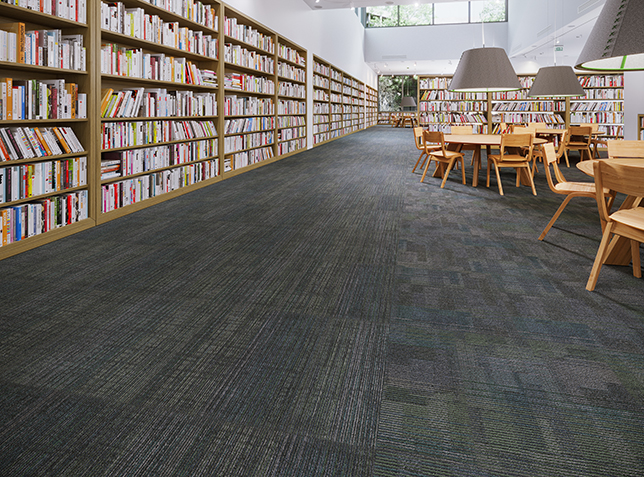
The “Necessary Action” and “Motivated Movement” styles from Mohawk Group’s new Taking Steps collection. Photo courtesy of Mohawk Group.
Each style comes in a range of nine colorways to match the aesthetic of a given education space. “Motivated Movement” offers a large-scale, bold, geometric arrangement designed for large, open environments. “Necessary Action” provides a classic, small-scale grid as a standalone or complement to other patterns. And “Adopt a Plan” covers the middle ground, offering a geometric design with an abstract twist.
“Not only is the collection multifaceted, but it is environmentally friendly, too,” continued Dettmar. “As a part of the Living Product Challenge, Mohawk Group is here to do our part to conserve resources and preserve the environment. We are proud to say that the Taking Steps collection is Net Positive for both carbon and water and achieves Living Petal Certification from the International Living Future Institute by complying with multiple imperatives.”
Photo caption: The “Necessary Action” and “Motivated Movement” styles from Mohawk Group’s new Taking Steps collection. Photo courtesy of Mohawk Group.
About the Author
Matt Jones is senior editor of Spaces4Learning. He can be reached at [email protected].