Texas Private School Breaks Ground on $3.5M Track & Turf Project
Fort Worth Country Day, a college preparatory school in Fort Worth, Texas, recently announced that ground has been broken on a $3.5-million athletics improvement project. Updates include renovations to its existing track and two athletic fields with higher-caliber surfaces and technologies, and the school will be the first venue in the Dallas-Fort Worth area to utilize them, according to a news release. The project is scheduled for completion in fall 2022.
One of the school’s field hockey fields will become a “wet” hockey field, which the press release notes is the “gold standard in competitive field hockey and comparable to fields played on during World Cup Field Hockey matches.” The water-based turf is manufactured by SporTurf and uses a water cannon irrigation system that allows the school to weather the field before use.
Secondly, the grass field at Rosacker Stadium will be replaced with a PowerBlade fiber-based turf surface field made by Shaw Sports Turf. The synthetic turf will act as padding to reduce shock absorption and also serves a temperature-control function that keeps it resistant to mildew, mold and salt.
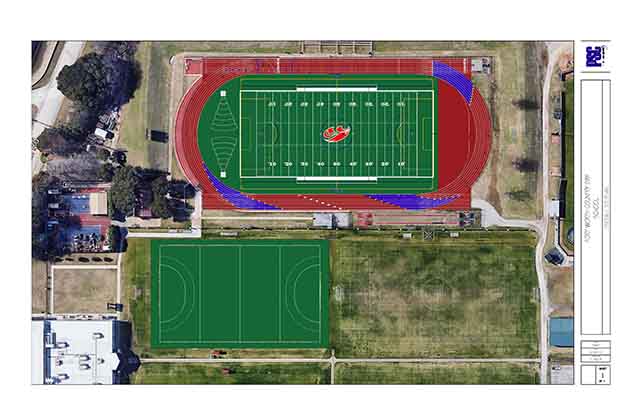
Finally, the school’s Barrett Havran Track will feature the PTS 4000 paved-in-place system made by Paragon Track Surfaces. The base mat will be sealed with two-component polyurethane to create a fully impermeable surface, according to the news release.
“Our track and turf fields improvement project is truly game-changing for FWCD athletics,” said Eric Lombardi, FWCD’s head of school. “No more rainouts because of saturated fields; no more worries about wear-and-tear during practices or competition. We’ll have the ability to host international-caliber athletic events, all while showcasing our 104-acre campus. My top priority, however, is to ensure that FWCD student-athletes are able to pursue their athletic interests on safe fields and surfaces that offer the highest level of standards for competitive sports. Calling this project ‘transformative’ would be an understatement.”
The project is being funded by 21 FWCD donors. Fort Worth Country Day is partnering with Paragon Sports Constructors as the project’s design/build partner.
About the Author
Matt Jones is senior editor of Spaces4Learning. He can be reached at [email protected].