Hands-On Learning Spaces: 5 Lessons From Career Tech
- By Bobby Williams
- 08/01/22
The expanding importance of STEM education
and project-based learning requires a rethinking of the traditional
school planning and design process. A practical way to start is to adopt a broader, non-traditional mindset, especially during a school project’s conceptual phases.
Fortunately, planners and designers can draw inspiration and
benchmarks from recent middle- and high-school projects, especially
innovations in career tech education (CTE) that depart
from conventional design and offer replicable lessons for improvement.
These early adopters’ experiential and career-based
learning focuses on integrating science and math-based opportunities
and coupling that mission with a hands-on, engaging
and highly relevant problem-solving curriculum.
The success of this model is found in the demand for career
technical education by a broad range of students interested in
today’s knowledge-based technology, science and health opportunities.
Two recent examples of applying the experiential lessons of
career tech in school design are the redevelopment of Bristol
County Agricultural High School (BCAHS) campus in Dighton,
Mass., and the new Dover High School and Career Technical
Center in Dover, N.H.
Bristol County Agricultural High School offers a rich curriculum
rooted in STEM and environmental education and supports
a working farm within its 220-acre campus. The school
offers its 640 students real-world experiences through seven
CTE programs: environmental engineering, animal science,
natural resource management, agriculture, floriculture, arboriculture
and landscape design.
Dover High School integrates academic with CTE education, allowing students the opportunity to choose from a range
of hands-on learning and skills-based education experiences.
Throughout the entire building, classrooms, social hubs and career
tech learning spaces are intermingled, bringing all students
together as a single learning community.
Five lessons drawn from the visioning,
planning and design of these
two schools offer practical and replicable
ideas for other communities
seeking new ways to think about
the future of project-based, hands-on
learning.
1. Think bigger from the start
To fulfill the aspirations of all partners
when planning a new school,
it is critical to develop a bold and
imaginative—but also clear—vision
that includes input from educators,
administrators, parents and community-based representatives and leaders. Their insights, as well as
their engagement and buy-in, will be important to the future
of the project—and ultimately to the future of the school. The
sharing of specialists’ knowledge, from inside the school and
out, is critical for earning buy-in and forging a school-specific
pathway to experiential learning success.
2. Engage subject matter experts and students
Engaging a
wider circle of advisors and subject matter experts throughout
the design process leads to a school experience matched closely
with the needs of today’s teachers and students. During the initial
stages of the BCAHS planning, HMFH met with teachers
from each career tech program, as well as outside advisors and
school partners to understand both high-level program goals as
well as critical infrastructure, technology and equipment needs.
Equally important were visioning sessions with students
from each program. For example, Animal Science students
provided key insights on the needs and possibilities of distinct
types of new labs, input that helped shape the lab layouts. Natural
Resource Management students joined the planning by
suggesting how their new natural history museum spaces might
function.
From these discussions, the museum exhibits became an integral
part of a new circulation path through one of the buildings.
Landscape Design students participated in the design of
the exterior plaza outside the new Student Commons. This visioning
process not only engaged students in real-life problem
solving, it also helped the students take “ownership” of the new
school facilities.
3. Design maximum flexibility
While seeming “technical”
by its nature, a school’s supporting mechanical, electrical, data
and other building systems carry an underappreciated yet vital
importance in career tech, STEM and other hands-on learning
spaces. Designing a robust, flexible and adaptable infrastructure
is essential to the future success of any school.
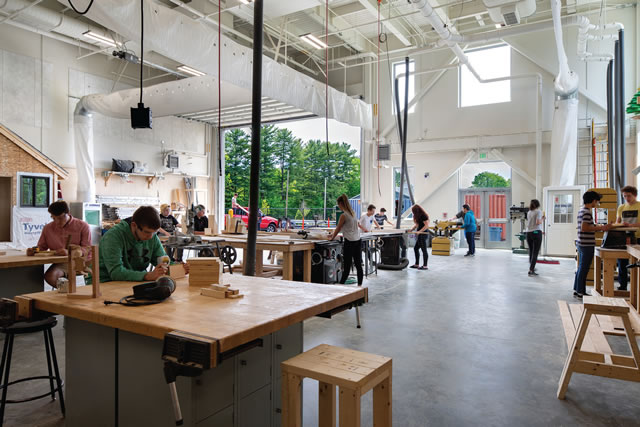
At Dover Career Technical Center, HMFH focused on providing
all the necessary infrastructure such as electrical, gas,
air, exhaust and more from overhead, while providing floor
drains for cleanup and access to water around the perimeter of
the shops. The careful coordination of this infrastructure allows
existing or new equipment to be located nearly anywhere in
the shops, providing maximum flexibility for the ever-changing
CTE spaces.
4. Build for maximum sustainability
The communities we work with are engaged
in a critical pursuit of environmental,
energy and climate change mitigation.
There are two universal benefits
in this. A sustainable and energy-efficient
building reduces operational costs, improves
learning outcomes and tangibly
slows climate change. While achieving
these objectives, a thoughtful and visible
sustainability program offers the potential
for a highly relevant and engaging
learning lab experience for students.
At Bristol Aggie, the entire school and campus is designed
as a learning tool. An outdoor green roof provides planting beds
with varying depths of soil to provide Floriculture students with
the opportunity to grow and maintain a rooftop garden. One
of the building’s mechanical rooms is located adjacent to the
Environmental Engineering labs and is accessible to the students
who will actively audit a projected LEED Gold building as part
of their curriculum.
5. Provide connections to nature
Multiple studies reveal
the benefits of creating teaching and learning spaces that connect
with the outside environment. Interest and excitement levels
rise dramatically when projects can expand to include both
indoor and outside experiences. Hands-on learning can also be
designed to incorporate the outdoors, even in urban areas. Interior
CTE spaces, especially those devoted to large project-based
work or “maker” activities, can extend to the outside.
The BCAHS campus includes outdoor classrooms, outdoor
dining and a multi-use amphitheater. Indoor spaces, such as
labs and other project-based learning spaces, can integrate nature
in creative and effective ways that support the curriculum
while also contributing to student health and wellness.
When rethinking future science and hands-on learning
spaces, dare to think big about what is possible. By harnessing
the input and ideas from the entire community, integrating
flexibility throughout, and working to exceed conventional
practices for sustainability, the outcomes will advance teaching
and learning forward for future generations of students.
This article originally appeared in the Summer 2022 issue of Spaces4Learning.