A Case for Campus Mailroom Efficiency
By Austin Maddox
The vast majority of university mail service centers were constructed prior to the advent of the digital age. Initially, most of the mail students received was in the form of letters that could be easily separated and then slotted into a small personal mailbox. There were no notices or alerts; a person simply checked their box sporadically to see if they had received a mail delivery. In terms of outgoing mail, services were minimal.
Now, in the days of social media and same-day shipping, receiving or sending a letter in the mail is an uncommon occurrence, while online shopping and package delivery have seen a meteoric rise. These technological developments have changed the way society views local and international mail services and have forever altered expectations around convenience. Campus mail services is now one of the most visible and important parts of auxiliary services at higher education institutions across the country. Between incoming mail and rising package delivery volumes, many universities are struggling with more deliveries than traditional mailboxes and small legacy mailrooms can handle.
One such example of this struggle occurred at a private, nationally recognized, four-year university located near the Blue Ridge Mountains. With a small and hard-to-access mail services center, there were more students than available mailboxes, and the mail center’s two full-time staff members and part-time student workers had to rely on a handwritten log to track deliveries that were too big or too numerous for the university’s existing mailbox infrastructure. Trying to find logged packages in the limited space led to long lineups and frustrating wait times when students came to pick up packages.
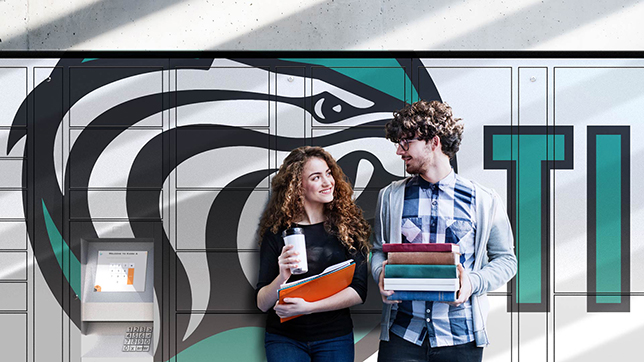
Photo courtesy of Quadient
The school found out about intelligent parcel lockers after discovering them at a National Association of College Auxiliary Services (NACAS) trade show. Management was convinced that lockers would be a perfect solution to the university’s mailroom headaches—and it was. For all those on campus, including the more technology-averse staff members, the smart locker technology has been easy to learn and even easier to use; it has been a game changer. With the smart locker solution, packages no longer need to be stored in the mailroom. This has helped the student mail services team reclaim valuable square footage in their small office. It has also made the package pick-up and management process a far more pleasant and efficient experience for everyone involved.
Three Key Benefits of an Efficient Mailroom
Updating mailroom processes to include a digital mailroom solution, such as digital mailroom software or smart lockers, can have many benefits for your institution, including:
- Improved space utilization: Digital mailroom solutions—such as mailroom management software, digital format previews of incoming mail, and smart lockers—require less space than more traditional methods, helping institutions maximize available space.
- Elevated student experience: Today’s consumers demand convenience – and college students are no exception to that rule. Any digital mailroom service that streamlines mail and package delivery and creates 24/7 access for student package collection will broker positive sentiment from both current and prospective students.
- Increased mailroom staff efficiency: Package delivery volume shows no sign of slowing down. Adapting your mailroom now ensures that mailroom staff can facilitate more deliveries and increase student satisfaction.
Improving mail and package delivery services can significantly improve the quality of campus life. Moving mail services into the 21st century creates gains not only in space, overall satisfaction and efficiency, but also provides a simple solution that can help college and university administrators take control of unexpected costs and reduce annual maintenance fees—and reduce complaints from students, faculty and senders.
Austin Maddox is Executive Vice President of North American Parcel Locker Solutions for Quadient.