Virginia Tech to Start Construction on New College of Engineering

Virginia Tech in Blacksburg, Va., recently announced that it has selected global construction and development firm Skanska to build a new 285,500-square-foot facility for the College of Engineering, according to a news release. Mitchell Hall will stand five stories and take the place of the existing Randolph Hall, which is scheduled for demolition in spring 2024. After completion, Mitchell Hall will increase gross square footage by 70 percent within the same footprint and be the largest building on campus.
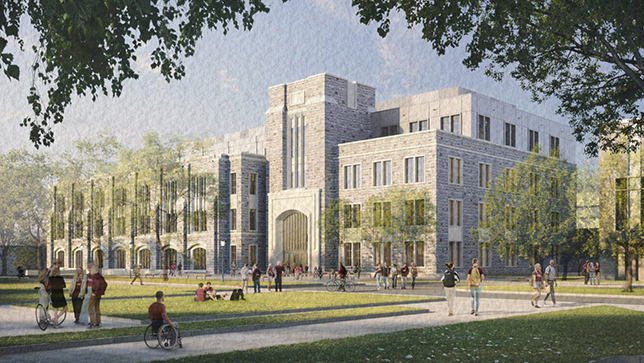

Rendering courtesy of Skanska

Construction will work around the university’s existing stability wind tunnel, one of the largest of its kind in the country. The building’s exterior will feature a mix of glass, precast concrete, and Hokie Stone. The interior will feature amenities like a 200-person, arena-style lecture hall, academic and administrative space, a flex research lab, and workspaces. The building will also play home to multiple departments within the College of Engineering.

“This project underscores our commitment to delivering cutting-edge academic facilities that inspire innovation and collaboration,” said Mark Balling, executive vice president with Skanska. “We have worked on many other projects at the university, and we are delighted to continue our partnership as we execute this transformative vision for engineering education.”

Construction has an estimated completion date of spring 2028, the news release reports.

About the Author

Matt Jones is senior editor of Spaces4Learning. He can be reached at [email protected].

Featured

  • Embry-Riddle Completes Construction on Research, Lab Facility

    Embry-Riddle Aeronautical University (ERAU) in Daytona Beach, Fla., recently announced the end of construction on a new research and lab facility on campus. The Center for Aerospace Engineering II (CAT II) will support aerospace research and technology development and broke ground last summer.

  • Designing the Bridge Between Inclusivity and Independence in K–12 Schools

    Fostering independence is fundamental to learning and development for K–12 students. It offers many proven benefits, such as enhanced confidence, problem-solving, decision-making, and social skills. However, this foundational objective loses its impact if it’s not accessible and adaptable to all students. Inclusivity plays a critical role in cultivating independence and healthy autonomy for students, fostering positive student learning outcomes by uniting pedagogy with the physical learning environment.

  • Year-Round Schools Require Year-Round Indoor Air Quality Planning

    While many schools are out for the summer, year-round schools follow a more “balanced” schedule with shorter, more frequent breaks spaced throughout the school year. Even though this offers educational benefits, these facilities have less downtime for building maintenance. This can become an issue when facilities managers overlook the importance of routine HVAC maintenance and air duct cleaning services.

  • Planning with Clarity: Using AI to Make Better Campus Decisions, Not Just Better Designs

    Higher education leaders are being asked to make increasingly high-stakes decisions about campus facilities amid greater uncertainty than ever before. Social and economic pressures, shifting enrollment, and evolving learning models compete with growing deferred maintenance needs to strain even the most robust infrastructure budgets.