Fayetteville State University Starts Construction on New Residence Hall

Fayetteville State University in Fayetteville, N.C., recently announced that construction has begun on a new $40-million residence hall, according to a news release. The building will have the capacity for 383 students and is scheduled for completion in fall 2025. The university partnered with KWK / Jenkins • Peer Architects for the project’s design.

The building covers 78,093 square feet and will stand four stories. Amenities will include single and double bedrooms each with a private bathroom, study rooms at the end of each wing, and a prominent central staircase, the news release reports.
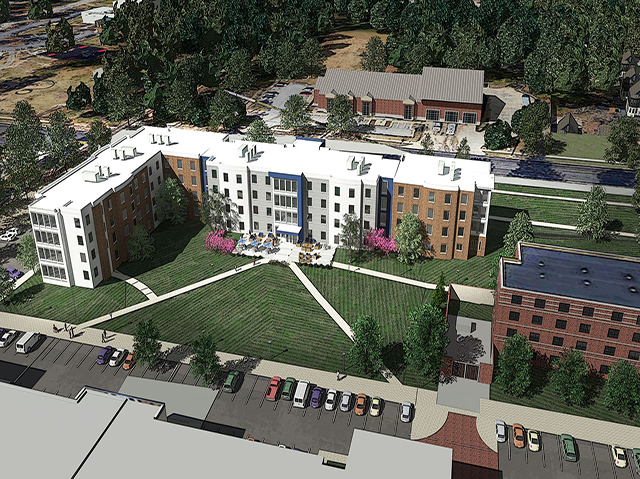

Image courtesy of KWK/Jenkins • Peer Architects

Architectural features of note include a large center lounge with large glass panes that overlook the campus. A glass surround staircase will match the designs of nearby McLeod and Renaissance Halls in the East Campus district.

The university also partnered with Metco as the project’s Construction Manager at Risk, according to the news release.

About the Author

Matt Jones is senior editor of Spaces4Learning. He can be reached at [email protected].

Featured

  • Benson Polytechnic High School in Portland, OR

    Preserving Legacy, Designing for the Future

    As historic academic buildings age, institutions face a difficult decision: preserve and adapt or demolish and rebuild. How do we honor the legacy of these spaces while adapting them to meet the needs of modern learners?

  • New Arizona Fine Arts School Reaches Construction Milestone

    Construction of the new Hilltop School for the Arts and Theater in Litchfield Park, Ariz., recently hit a significant milestone, according to a news release. The Agua Fria High School District held a beam-signing ceremony to celebrate the building’s topping out, or the placement of its last structural beam.

  • A digital silhouette works at a computer, immersed in a glowing, interconnected world

    How Will AI Transform Learning Space Design?

    For years, higher education has designed learning spaces around technology as a tool for display, capture, collaboration, and connectivity. AI changes that equation.

  • abstract illustration of school gym

    How the Gymnasium Can Serve as a Model for Learning Space Design

    Multipurpose gyms work because flexibility was built into the brief from the start, not retrofitted later. The same logic applies to academic spaces.