Scientifically Advanced Research Complex Completed at Arizona State

Studio Ma has unveiled their innovative, scientifically advanced building concept created for Arizona State University’s planned ISTB-7 — an interdisciplinary science and research complex with a vast atrium biome full of plants and water.
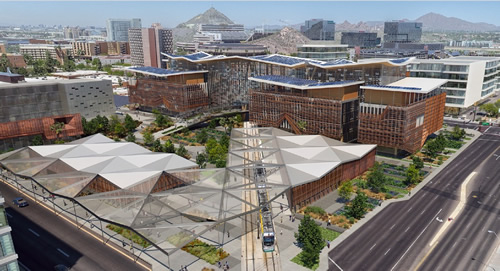
ASU Science Center

Bringing together regenerative and bioclimactic technologies, ISTB-7 is conceived as a highly sustainable science and technology center for the ASU Tempe campus. The transit-oriented solution includes a light rail station, and the structure’s climate-responsive, regenerative technologies transform it into a source of energy, water, carbon and other nutrients.

The Studio Ma design for the Interdisciplinary Science & Technology Building, or ISTB-7, ensures it will produce enough carbon, energy, water and waste to achieve triple net-zero performance. To do so, ISTB-7 building materials absorb carbon and convert it to life-giving nutrients for durable materials and enriched soil. Its atrium biome purifies waste air, and a wetlands landscape recycles water using natural, bio-based methods. Rainwater is collected, and sun shades keep the interiors cool and comfortable.

Materials incorporate ASU’s own cutting-edge scientific research on integrated carbon-capture technology. Methods to save and produce energy include air currents, evapotranspiration and photovoltaics. The complex treats and recycles sewage for use as greywater using low-energy, bio-based systems. With its rail transit connection, the complex creates a new campus gateway.

Featured

  • Niles West High School Natatorium Renovation

    Natatoriums are highly specialized spaces, and luminaires in this setting face several unique challenges. Perhaps the most significant is corrosion, which is exacerbated by high indoor humidity, condensation, and pool chemicals, often resulting in material degradation in luminaires not certified to perform in corrosive environments.

  • DLR Group Appoints New K–12 Education Practice Leader

    Integrated design firm DLR Group recently announced that it has named its new global K–12 Education leader, Senior Principal Carmen Wyckoff, AIA, LEED AP, according to a news release. Her teams have members in all 36 of the firm’s offices in the U.S., Puerto Rico, the U.S. Virgin Islands, Europe, and Asia.

  • UNL Kiewit Hall

    Designing for Engineering Excellence: Integrating Sustainability and Wellness at UNLs Kiewit Hall

    Kiewit Hall at the University of Nebraska-Lincoln exemplifies how academic institutions can integrate sustainability and wellness into modern learning environments. With an integrated and collaborative team approach, Kiewit Hall addresses enhanced learning and creativity, physical health, and mental wellness, and fosters a sense of community through innovative design, operations, and policy solutions.

  • Spaces4Learning Trends & Predictions for Educational Facilities in 2026: Part II

    As education leaders look toward 2026, the design of K–12 and higher education facilities is being reshaped by powerful, converging forces. Survey respondents point to the rapid growth of Career and Technical Education, deeper alignment with workforce and industry needs, and the accelerating influence of AI and emerging technologies.

Digital Edition