Work Begins on New First-Year Residence Hall at DePauw University

GREENCASTLE, IN – Site preparation work has begun where the first of four proposed residence halls for DePauw University's first-year students is set to be built.

The new residence hall is one of several investments in the campus planned to enhance the student experience and increase sustainability. The construction of a solar array to convert to renewable energy sources begins in April; the opening of the Ullem Campus Farm is planned for May; and infrastructure work for the Campus Energy Master Plan continues in June.
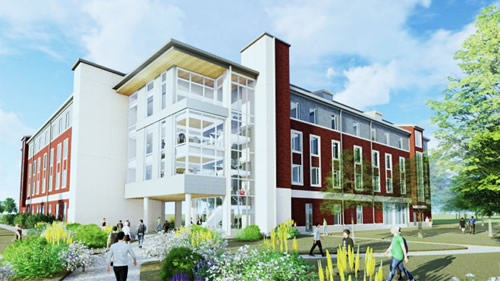
DePauw Residence Hall

This first hall will provide 152 student beds, most of them in double rooms. The first floor of the four-story, 60,400-square-foot building will feature community-living space—the entry, a lounge, a kitchen and the like—and the top three floors will contain students’ rooms. The project will cost approximately $23 million.

Construction work likely will begin in June and is expected to be completed in summer 2020.

Featured

  • concentric silhouettes of a human head

    How Physical Space Shapes the Mind: Designing for Better Learning Outcomes

    Research in environmental psychology and neuroscience increasingly suggests that the way a room is designed can influence memory, focus, or even a student's sense of belonging.

  • Indiana Wesleyan University Schedules Grand Opening for New Welcome Center

    Indiana Wesleyan University recently announced that it will soon open a new Welcome Center on its campus in Marion, Ind., according to a news release. The facility will serve as the home base for prospective students and their families to learn more about the university and student life there. A ribbon-cutting ceremony is scheduled for February 19.

  • UCNJ Launches $30M Modernization of Physical Education Center

    The Union College of Union County (UCNJ) in Cranford, N.J., recently broke ground on a new $30-million modernization project for its Physical Education Center (PECK), according to a news release. The college partnered with DIGroup Architecture for the project’s design, transitioning the existing 42,000-square-foot structure into a campus hub for student athletics and campus life.

  • Different Starting Points, Same End Goal

    Higher education campuses can enhance student experience by implementing mobile credentials to streamline building access, on-campus payments, and access to other amenities. This enables students to connect to their campuses through the technology they use most: their mobile devices.

Digital Edition