State-of-the-Art Health Sciences Building Underway at Assumption College

WORCESTER, MA – Construction has begun on a new 41,000-square-foot Health Sciences Building at Assumption College. A groundbreaking was held on May 10 and construction will be completed for the fall 2020 semester. The facility was designed by Nault Architects, Lauring Construction is serving as general contractor on the project.
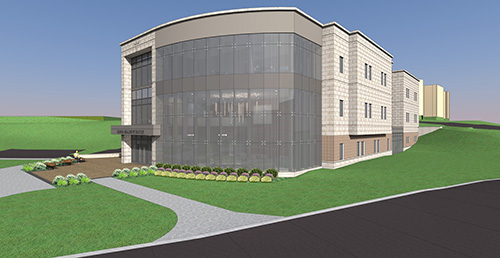
Assumption College Health Sciences Building

The Health Sciences building will house the nursing and physician assistant studies programs set to open in fall 2020, but will benefit students in all disciplines. The nursing floor will feature a large nursing skills lab with seven full-sized hospital beds for teaching patient care. Four simulation labs will have hi-fidelity manikins which can simulate actual patient conditions (vitals, seizures, cardiac arrest, childbirth, etc.) ,all of which can be controlled remotely by a simulation lab technician.

Throughout the spacious building with an interior illuminated by natural light, students will have access to lounges, smaller break-out space and de-briefing rooms and conference rooms, nine offices for faculty and staff, and suites for each of the deans.

Featured

  • Charles R. Drew University Opens Health Professions Education Building

    Charles R. Drew University of Medicine and Science (CDU) has officially opened its new Health Professions Education Building (HPEB) in South Los Angeles.

  • Florida Gulf Coast University Selects Builder for New Academic Building

    Florida Gulf Coast University in Fort Myers, Fla., recently announced that it has selected development and construction firm Skanska to build a new academic and health sciences building, according to a news release. Marieb Hall South will become the campus’ largest academic building at 158,040 square feet.

  • Designing the Bridge Between Inclusivity and Independence in K–12 Schools

    Fostering independence is fundamental to learning and development for K–12 students. It offers many proven benefits, such as enhanced confidence, problem-solving, decision-making, and social skills. However, this foundational objective loses its impact if it’s not accessible and adaptable to all students. Inclusivity plays a critical role in cultivating independence and healthy autonomy for students, fostering positive student learning outcomes by uniting pedagogy with the physical learning environment.