Mohawk Group Debuts Data Tide Carpet Collection
Commercial flooring solutions company Mohawk Group has announced the release of its Data Tide collection, a variety of modular carpet planks with a design evoking the visualization of water.
According to a news release, the collection “celebrates the unique ecosystem of estuaries where freshwater and saltwater converge to sequester Blue Carbon and support biodiversity.” Mohawk designers used the visualization of data sets from studies of greenhouse gases to create a series of planks celebrating the ecological influence of blue carbon, carbon stored in coastal and marine ecosystems.
“At Mohawk Group, we are committed to preserving our water ecosystems,” said Jackie Dettmar, vice president of commercial marketing and product development. “We strive to help customers create spaces that are environmentally responsible, and we’re expanding these efforts to encourage respect for rivers, waterways and the diversity of life they make possible.”
The 12-by-36-inch modular carpet planks come in eight colorways and feature color gradations flowing from light to dark that resemble transitioning waters. Flooring from the Data Tide collection can be placed with any other Mohawk Group soft or hard flooring solution, as well as paired with its finishing accessories.
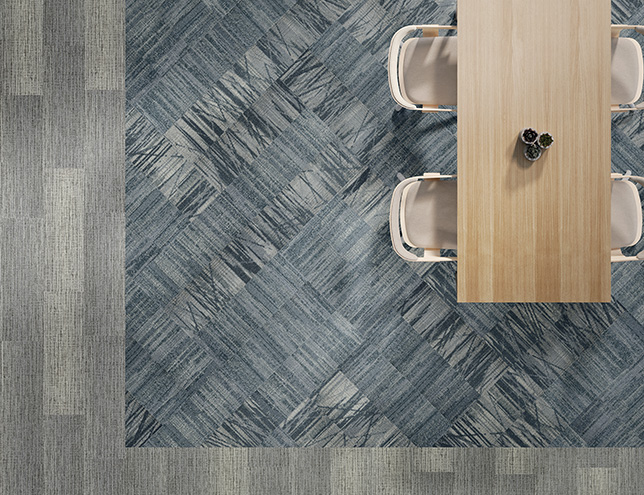
Photo credit: Mohawk Group
“Data Tide’s three coordinating patterns—Aqua Rhythm, Biome and River Code—feature a combination of solid, heathered and twisted yarns for a dimensional texture that reflects water’s movement. The patterns are designed to work together and independently in a product suite, maximizing creative vision and inspiring a relationship with nature,” said Royce Epstein, A&D design director for Mohawk.
The Data Tide collection is just one element of Mohawk’s sustainability program, The Waterways Project. The project features products, technologies, and initiatives aimed at protecting and restoring riverways. In addition to the designs themselves encouraging mindfulness of aquatic ecosystems, the products were constructed to be toxin-free and socially responsible and to have a positive impact on the environment.
About the Author
Matt Jones is senior editor of Spaces4Learning. He can be reached at [email protected].