Houston-Area District Opens STEM Magnet Academy
The Stafford Municipal School District (SMSD), located near Houston, Texas, recently opened a new Science, Technology, Engineering and Mathematics (STEM) Magnet Academy. The $2.8-million facility is the first of its kind in Fort Bend County, and it can accommodate almost 200 students in grades 3–8. According to a press release, the school’s curriculum will focus on 21st-century skills like medical technology, coding, robotics and more.
“The SMSD philosophy is ‘STEM to Learn, STEM to Earn,’ and it was really built and born here,” said SMSD Superintendent Dr. Robert Bostic. “Eight years ago, we started with incorporating robotics, drones SWIFT coding, and gaming into our curriculum because we looked at the future outlook of where jobs would be. We came up with these plans—including our newest jewel, the STEM Magnet Academy. In its inaugural year, students are set up for success through project-based curriculum, partnerships, mentorships, and we’re also planning for international travel when it’s safe to do so. We are cutting and blazing a path that others have not done.”
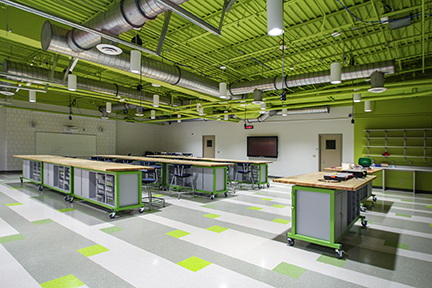
Photo courtesy of Lockwood Andrews & Newnam, Inc. (LAN)
The new academy measures in at 67,000 square feet and features amenities like 32 classrooms, two science rooms, a gaming room, a medical and coding lab, a robotics lab and a reading room. It also includes breakout areas for collaboration and a learning staircase allowing two teachers to combine their classes and offer larger-group instructions.
“Unlike Career and Technical Education programs that are typically offered to high school students, this STEM Magnet Academy will prepare students to learn specialized skills like coding and robotics from an early age,” said Victor Fleming of Lockwood Andrews & Newnam, Inc. (LAN), which served as the program manager for the bond program.
The facility was designed by AutoArch Architects and constructed by Jamail & Smith Construction. It was built as part of a $62-million bond program that passed in November 2017. The ultimate goal of the bond was to provide funds to address growth and expansion within SMSD, which enrolled about 3,600 students during the 2019-20 academic year. SMSD is the only municipal school district in Texas.
About the Author
Matt Jones is senior editor of Spaces4Learning. He can be reached at [email protected].