Arizona State Envisions Office Park in Space
- By Dian Schaffhauser
- 11/17/21
The ultimate coworking space for digital nomads is on the drawing board. Working alongside others, Arizona State University is developing a space station that acts as a business park.
"Orbital Reef," as it's being called, will be situated in low Earth orbit and enable companies to run operations for research, manufacturing, travel, education and exploration. They'll lease space in the facility, akin to current coworking setups, with a big exception. People will have to live on board, at least for short periods.
The collaborative project is being led by the School of Earth and Space Exploration Interplanetary Initiative, headed by Professor Lindy Elkins-Tanton. She is also a principal investigator of the Psyche mission, an ASU and NASA space mission to visit a metal asteroid orbiting the Sun between Mars and Jupiter.
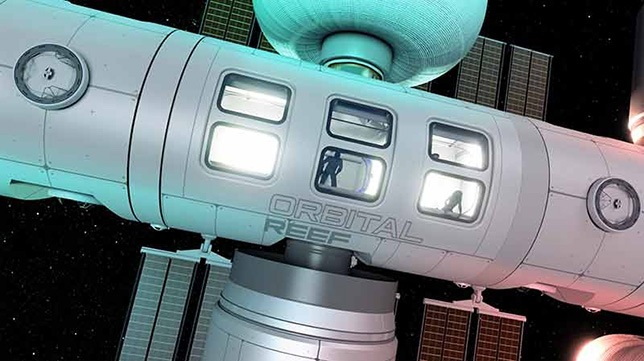
Rendering of the Orbital Reef space station. Courtesy of Blue Origin Media.
Elkins-Tanton said the goal of Orbital Reef is to make space exploration "accessible for so many more people who can participate in many different ways." The expectation is that sharing the expense and complexity of living and working in low Earth orbit will open the "space economy" to small businesses and nations.
ASU is working with a number of space companies on the project, including Jeff Bezos' Blue Origin, Sierra Space, Boeing, Redwire Space and Genesis Engineering.
The Interplanetary Initiative runs an advisory council with representatives from more than a dozen international universities. According to ASU, their goals are to "establish guidelines and standards of conduct for ethical research on the station, provide consulting for those new to space research, channel academic research onto Orbital Reef, inform the academic user experience aboard the station and conduct STEM outreach and education programs."
The project hosts a 6,800-square-foot lab that serves as a research and development workspace where companies collaborate with students, faculty and staff to design, build and test space hardware and software.
Officials said the research topics they're currently exploring in the project include these:
- How can we sustain healthy communities in space?
- How will we manage shared resources in space, from satellites and space debris to minable asteroids?
- How can we better connect humans and robots in space exploration?
- How would humankind react to the discovery of alien life?
"Humans are compelled to explore; it's in our bones. We will become an interplanetary species," Elkins-Tanton said, in a statement. "We have an opportunity to use the inspiration of space exploration to take better care of the Earth by involving all of society and driving technological advances that will help solve problems here below."
"Shifting our mindset to see ourselves as a team of crewmates aboard a space vessel — Earth — opens the door to shared purpose and better cooperation," added Jessica Rousset, deputy director of Interplanetary Initiative.
About the Author
Dian Schaffhauser is a former senior contributing editor for 1105 Media's education publications THE Journal, Campus Technology and Spaces4Learning.