Wenger Launches LED Light Fixture

Music and theater education solutions company Wenger Corporation recently announced the launch of the Novara LED light fixture, according to a news release. The product was intentionally designed as a retrofit for Diva Acoustic Shells, allowing venues to upgrade light fixtures within those shells to save on electricity costs without replacing the entire setup.

The news release reports that Novara serves as the only LED fixture designed as a 1:1 replacement for incandescent fixtures installed in the existing Diva Acoustical Shells. The LED bulbs offer comparable beam angles and lumen output to provide shell lighting of performance spaces at a more sustainable cost.
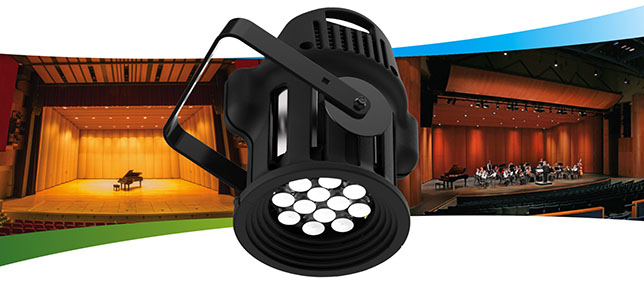
Novara LED Fixture
Photo Courtesy of Wenger Corporation

The Novara LED fixture offers a brightness of 6,800 lumens to fully illuminate the venue’s stage area. The new fixtures are also silent, lacking any buzzing or humming noises that might distract from a performance. The energy-efficient bulbs exude minimal heat and no ultraviolet or infrared radiation. They can also save organizations up to 86% on electricity costs and consumption.

The fixtures are individually controllable and addressable using DMX/RDM or mains dimming technology. The two-axis beam positioning allows for easy adjustability and fine-tuning to tailor it to a given performance. The bulb also has a lifespan 35 times as long as its predecessor, reducing both maintenance times and replacement costs.

About the Author

Matt Jones is senior editor of Spaces4Learning. He can be reached at [email protected].

Featured

  • Agricultural Sciences Complex

    Agricultural Sciences Complex

    Established in 1999, the Education Design Showcase is a vehicle for showing off innovative — yet practical — solutions in planning, design, architecture, and construction. The College of Western Idaho's Agricultural Sciences Complex has been recognized with an EDS 2026 Grand Prize award in the category of New Construction.

  • Rethinking K-12 Schools as a Continuous Learning Experience

    Most students move through three or more separate facilities during their K-12 journey, yet the built environments they encounter at each stage have traditionally been designed in isolation, with little continuity in spatial language, learning philosophy, or physical resources. Each new school is a reset with different layouts, learning models, expectations, and ways of moving through a building. The next generation of school design is making the case that the first day of kindergarten and the last day of high school can and should feel connected through common support systems and infrastructure in the physical environment.

  • school building with glowing circuit board patterns

    AI Is Coming to Schools — But Most School Buildings Still Run on Institutional Memory

    As school districts race to introduce AI into classrooms, administration, and curriculum planning, another conversation is happening behind the scenes: How prepared are school facilities themselves for the operational demands AI will create?

  • R.I. District Holds Ribbon-Cutting Ceremony for New Elementary School

    Cranston Public Schools in Cranston, R.I., recently announced the completion of Gladstone Elementary School, according to a news release. The 100,000-square-foot facility serves as a replacement for the 1950s-era former building, and it consolidates the student, faculty, and staff populations of Gladstone and Arlington Elementary Schools.