Intelligent Buildings: At What Cost?
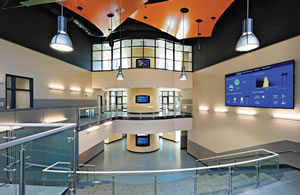
PHOTO © TOM SIBLEY/WILK MARKETING COMMUNICATIONS
Controls are the future for building management.
They allow end users to understand how, when
and why their structures use energy down to a granular
level. They can make spaces more comfortable, efficient and
easier to maintain. But they add cost that may seem prohibitive at
construction time. The Continental Automated Buildings Association
(CABA) joined forces with market research experts Frost& Sullivan to study applying life-cycle costing to building controls.
They, and other experts, weigh in on the matter.
The Paper
In a study written in 2013, CABA and Frost & Sullivan had
several objectives in mind, but the overarching theme is evaluating
the role of life-cycle cost (LCC) as a valid prerequisite in the
process of adopting intelligent building design, technology and
processes. They hoped their work would address many components
of the issue, including adequate training and education efforts,
exploring collaborative efforts to make LCC mainstream and
identifying actionable items for effective industry changes.
Using a controlled, 150-sample survey
conducted among building owners and
asset managers the group uncovered
many tantalizing facts about LCC. These
include what college and university facility
managers probably already know: that
there is a need for financial justification;
other simple payback analyses often stand
in for LCC; LCC tools and calculations
are complicated and, most importantly,
a collaborative approach that includes
consultants, owners, vendors and service
providers is needed to integrate LCC into
the building process.
Farah Saeed, principal consultant, energy
and environment team, Frost & Sullivan,
acknowledges that college and university
buildings have adopted building controls
on a “partial level.” She notes that it’s common
to see lighting and HVAC controls in
place. But she also states that there is “no
unified message or education in place.”
Saeed further says that the best intentions
often get diluted at they work their
way through the actual building process.
“There are so many stakeholders involved
in the process,” she says of the architects,
engineers, subcontractors and distributers
involved in constructing a building.
“Unless you have a single advocate to
make sure technology is deployed it might
not end up in a building even if it was
specified.”
Saeed looks to a time where there is a
unified message and organized education
and training that will make justifying the
costs of building controls easier.
The Practice
The results Saeed sees in the paper
concur with what professionals encounter
in the field. Matt Gates, vice president,
Energy Management Services & Solutions,
Trane, notes that there is a strong
adoption of controls on most campuses,
usually in the HVAC system. “It can be
hit or miss with lighting,” he says. “Older
buildings are not as easy to retrofit but
newer structures usually have controls.”
He also notes a change in control technology
that is moving from a large panel in
an electrical room to a mobile device.

PHOTO COURTESY OF SUFFOLK COUNTY COMMUNITY COLLEGE
LOOKING SMART. The new Life Sciences Building at SUNY Suffolk County Community College in Selden, NY (seen here and
on page 30), designed by BBS Architects, includes displays in real-time detailing the building’s energy consumption and
the amount of electricity harvested from its rooftop photovoltaic panels. Both the interiors and the site feature learning
tools related to the building’s operations, design and function.
Gates mentions that he does see
schools asking for an added overlay to
their control system. His company offers
BENS, a live dashboard that users can
access to pull up and see interactive meter
data. “A CFO will look at the data differently
than a facility manager,” he says.
Gates admits that a system like BENS will
not offer immediate savings in reduction
in staff, so schools have to look at it with
an eye towards the long haul. “It will help
a maintenance department troubleshoot
and prioritize problems,” he says. “You
will see a savings in energy.”
Max McLeod, national business development
manager, Siemens Industry, Inc.,
agrees with another of Frost & Sullivan’s
findings; the piecemeal nature of a given
building’s various systems. “The specs are
written by different people,” he says, noting
that a mechanical engineer may write
the automation and control piece while a
different consultant handles the fire safety
system and a third person is in charge
of the security. “This approach does not
encourage cohesiveness.”
McLeod does see a trend towards collaborative
design, especially in a Building
Information Modeling (BIM) environment.
Still he notes that there are too often many
different systems running on many different
platforms in a single structure. In answer,
Siemens offers a “universal remote”
solution with their Desigo CC.
“The view can be partitioned so different
stakeholders can see what they need,”
explains McLeod. “Of course you can
manually manage individual systems, but
this smooths the process and eases decisions.”
Even complicated problems like
whether it’s cheaper to get energy commercially
or from a co-generation plant
become easier with a tool like this.
This, of course, makes it attractive to
facility managers. McLeod admits that a
formal life-cycle costing metric like the
kind CABA identifies is not often applied.
He does, however, offer an eye-catching
stand-in: a performance guarantee.
“We can measure how much energy this
system will save,” he says. Schools then
can use their operating money to make a
capital improvement and, if those savings
aren’t realized, “we write you a check.”
This article originally appeared in the issue of .