Facilities Masters Award
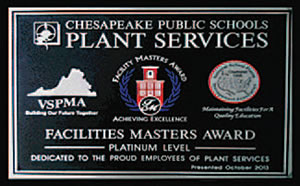 The Facilities Masters Award is presented to school divisions that have successfully completed a comprehensive self-evaluation of their maintenance department based on criteria as set forth by the National School Plant Management Association. The award is comprised of several domains that reflect best practices in managing and providing the delivery of exemplary customer service.
The several domains include Maintenance Planning, Facility Audit, Safe Environment, Maintenance and Managing, and Evaluating Facilities. In addition, the application allows a school division to identify exemplary practices that may not be included in the application.
The Facilities Masters Award originated from the Planning Guide for Maintaining School Facilities. This document was developed in 2003 by the School Facilities Maintenance Task Force of the National Forum on Education Statistics. The Facilities Masters Award initially grew out of the Planning Guide and was then promoted by the National School Plant Management Association.
In 2005, the Association of School Business Officials (ASBO) and SchoolDude.com collaborated to promote the award and in turn many school divisions were recognized from then to 2008. In 2008, the ASBO announced it could no longer support the award. As a result, in 2009, the Virginia School Plant Managers Association (VSPMA) decided to continue the award based upon the criteria outlined in the Planning Guide.
Individual states have the ability to add or modify the original documentation put forth in the Planning Guide to meet their specific expectations or state mandates. The National School Plant Management Association and the VSPMA are actively promoting participation in the award program throughout the country.
The Facilities Masters Award may be awarded at three levels. Those levels are Platinum, Gold, and Silver and are based on accomplishments of the school divisions.
- The Platinum Award requires 254 points or above
- The Gold Award requires 228-253 points.
- The Silver Award requires 200-227 points.
The time needed to complete the application process may vary from state to state and/or a school district’s ability to access data. A recommended practice would be to assign each section of the application to those individuals in the organization that are directly responsible for those functions/duties. This will make data collection more manageable and will allow a team to complete the task in a timely manner.
Documents selected should clearly reflect the maintenance department’s ability to execute assigned tasks at a high level of success. Monitoring the progress of the data collection by having clearly established deadlines will ensure that the application is progressing. Once documents are approved for each domain, in order to submit an application, scan each document and place them into the assigned domain area. This will create a master PDF file to submit with the completed application. Once this process is complete, it is time to submit the documentation for review.
The application will be assessed based upon the outlined Facilities Masters Award criteria. The evaluation process is designed to provide feedback on the application as well as areas for improvement. Submitting an organization’s information for an independent evaluation may be uncomfortable; however, the benefits of being recognized by a national organization and receiving constructive feedback will help any organization continue to make strides in assuring that its schools are maintained to their highest possible level.
There are many benefits for participating in the Facilities Masters Award program. Taking the time to complete the application allows a department to self-evaluate its current maintenance practices and procedures. It can also help to validate current operational performance by using established guidelines for maintaining high professional standards. The information, timelines and application can be found at www.vspma.org under the Facilities Masters link. School buildings must continue to be maintained to the highest standards so students have the best opportunity to develop physically, socially, emotionally and academically.
This article originally appeared in the issue of .
About the Author
John A. Bailey, Ph.D. is the director of School Plants for Chesapeake Public Schools and a National School Plant Managers Association board member, representing Virginia, and a Virginia School Plant Managers Association board member, representing Region II, in Virginia.