St. Elizabeth Ann Seton School
Project Snapshot
PROJECT: St. Elizabeth Ann Seton School
LOCATION: Keller, Texas
COMPANY NAME: Stonhard
WEBSITE: www.stonhard.com
THE CHALLENGE
The design decision makers at St. Elizabeth Ann Seton School, in Keller, Texas, set out to complete corridor and restroom floors to meet the needs of their school. The criterion was wear-resistant floors that would stand up to continuous foot and cart traffic while reducing noise. They also required floors that are easy to keep clean and safe, even when slippery. Finally, this forward thinking school wanted design and color integrated into the overall décor.
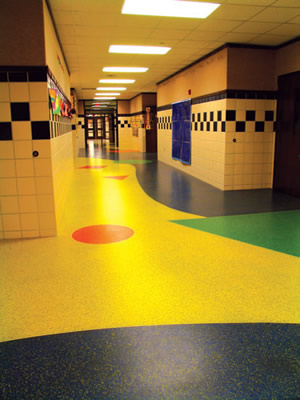
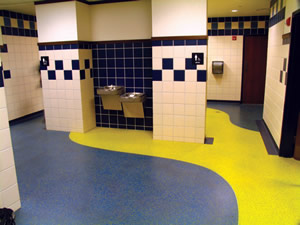
Colors and geometrical patterns guide students through hallways and corridors while providing a bright and inspiring environment.
THE SOLUTION
Terrazzo flooring was originally specified for the job, until a strong recommendation from a general contractor changed the minds at St. Elizabeth’s. The general contractor had recently worked with Stonhard’s commercial product line and he endorsed Stonhard based on his experience on a construction management level, as well as the quality of the products. They presented the school with an option to traditional terrazzo, Stonres RTZ, a seamless, urethane system infused with rubber aggregate chips. This system provides exceptional acoustic efficiency and ergonomic comfort while providing a superior wear and stain resistant floor.
It is also offered in the colors and dynamic design scheme the school was seeking. Multi-colored aggregate in a highperformance matrix allows Stonhard to create intricate patterns and incorporate geometric shapes in an endless palette of colors. The use of a unique rubber aggregate produces much quieter floors and eliminates echoes and reverberation.
The installation of the Stonhard floors in the school’s new wing was done in November of 2004. The floor was ready for foot traffic after only 12 hours, and within 48 hours it was available for full service.
IMPACT ON LEARNING
Towards the completion of the installation, a teacher stopped the Stonhard Project Manager to let him know the floors had changed how both teachers and students felt about their building. She said, “The floors really make a difference.” The floors at St. Elizabeth Ann Seton motivate staff, students and parents with bright, bold colors and patterns and have helped to fuel an environment that is educational and imaginative. With its new flooring, the school has become a place where creativity is encouraged with colorful and durable floors that require minimum maintenance. The projects initial goals, student comfort and safety, have been met and surpassed thanks to the flooring choices.
Editor's Review
We have learned that our most successful schools provide a welcoming atmosphere. We also know that color impacts student achievement, as well as teacher effectiveness and staff efficiency. Research has demonstrated that specific colors influence the health, morale, emotions, behavior and the performance of learners. When you apply that to school flooring, and couple that with longevity and safety factors, the result is definitely going to have a positive influence on a student’s ability to learn and the school’s ability to use more of its resources for hands-on educational expenses.
This article originally appeared in the issue of .