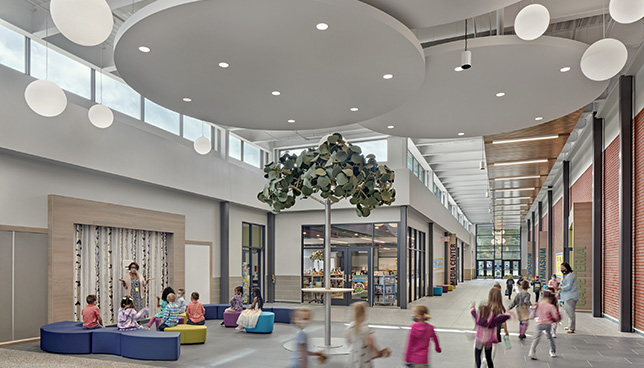
Most students move through three or more separate facilities during their K-12 journey, yet the built environments they encounter at each stage have traditionally been designed in isolation, with little continuity in spatial language, learning philosophy, or physical resources. Each new school is a reset with different layouts, learning models, expectations, and ways of moving through a building. The next generation of school design is making the case that the first day of kindergarten and the last day of high school can and should feel connected through common support systems and infrastructure in the physical environment.
Montclair State University in Montclair, N.J., recently announced the completion of a new virtual reality learning facility developed in partnership with Dreamscape Learn, according to a news release. The 2,450-square-foot lab space is inside the College of Communication and Media building and will serve students pursuing careers in digital media, virtual reality, and content creation.
The Fort Bragg Unified School District (FBUSD) in Fort Bragg, Calif., recently held a ribbon-cutting ceremony for Noyo High School, a continuation high school that provides alternative education options for students in grades 6–12, according to a news release. The district partnered with Quattrochi Kwok Architects for design and FRC Inc. for construction, and the project’s funding came from Local Bond Measure B.
Integrated design firm DLR Group recently announced that it has brought three new hires on board to help shape its higher education practice in California and the northeast, according to a press release.