Oil Boom Funds Collaborative Learning Future
Collaborative Learning

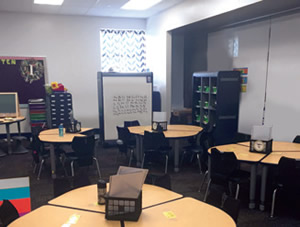
Furniture from Smith System helped turn the MISD elementary schools into fully-functional 21st century learning environments.

Midland Independent School District (MISD) in West Texas has approximately 24,000 students spread throughout its many campuses. Recently, the district faced a major challenge — a population boom, fueled by surging oil production in the area’s Permian Basin.

Between 2010 and 2014, Midland’s community population increased by nearly 25 percent. In turn, new families swelled the district’s K-12 classrooms to capacity, requiring the district to install over 75 portable classrooms throughout its 36 campus sites. This strain was particularly felt in the primary grades.

In November 2012, voters passed a history-making $163 million elementary schools bond initiative. The bond would provide major funds for renovations and improvements at MISD’s 24 elementary campuses, and construct three new K-6 elementary schools (opened in fall 2015).

For MISD educators and staff, the bond offered tremendous opportunity to provide 21st Century Learning environments for its youngest students.

For classroom furniture, the district wanted to look at higher quality products with a longer life span and the ability to foster the desired collaborative environment. Lone Star Furnishings, an independent furniture distributor working with MISD, suggested MISD’s team visit the showroom of Smith System, a K-12 furniture manufacturer, in Plano, TX.

The choice was clear. MISD made Smith System its district standard for elementary furnishings purchased with the new bond money — for existing elementary schools and the new ones built. To fit the collaborative learning model, the district chose classroom furniture and storage units with casters for quick reconfiguration, and seating with maximum flexibility to help keep kids comfortable and focused.

www.smithsystem.com

This article originally appeared in the issue of .

Featured

  • Rethinking K-12 Schools as a Continuous Learning Experience

    Most students move through three or more separate facilities during their K-12 journey, yet the built environments they encounter at each stage have traditionally been designed in isolation, with little continuity in spatial language, learning philosophy, or physical resources. Each new school is a reset with different layouts, learning models, expectations, and ways of moving through a building. The next generation of school design is making the case that the first day of kindergarten and the last day of high school can and should feel connected through common support systems and infrastructure in the physical environment.

  • Spaces4Learning Announces 2026 Product Award Winners

    Spaces4Learning has just announced the winners of the 2026 Product Awards! The award program spotlights outstanding product development achievements of manufacturers and suppliers whose products or services are considered to be particularly noteworthy in their ability to enhance K–12 and higher-education learning environments.

  • Wold Completes Geothermal Projects at Two Minnesota Schools

    Wold Architects & Engineers recently announced that it has completed two geothermal expansion projects for Mounds View Public Schools in Shoreview, Minn., according to a news release. The work at Highview Middle School and Irondale High School serves the district’s long-term goal of reducing energy costs and dependency on non-renewable fuel sources, as well as improving building performance.

  • Cal Poly Humboldt Starts Construction on Healthcare Education Hub

    California State Polytechnic University, Humboldt in Arcata, Calif., recently announced that work has begun on a renovation project that will turn the Stewart Building into a new Healthcare Education Hub, according to a news release. The university is partnering with Sundt Construction Inc. for construction services.