Porous Asphalt Pavements
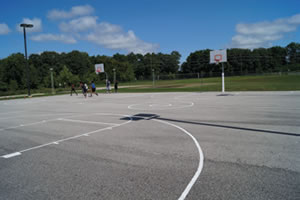
POROUS ASPHALT can be used for roads, trails, parking lots and recreational facilities, like this porous asphalt basketball court.
Imagine a parking lot without puddles, a bike trail that requires less salt to keep ice-free in winter, roads that redirect stormwater and filter it back into local aquifers. Porous asphalt pavements can do all this and more.
Porous asphalt pavements with stone reservoirs are a multifunctional low-impact development (LID) technology that integrates ecological and environmental goals for a site with land development goals. They are constructed using the same equipment and techniques as conventional asphalt pavements, and provide a cost-effective means for improving the sustainability of facilities.
How It Works
Porous asphalt pavements have been used successfully since the 1970s and have performed well in all climate zones. A porous pavement system consists of a subsurface reservoir filled with larger stones, topped by one or two layers of porous asphalt. The porous asphalt mix is much like typical asphalt mixtures except that it lacks finer material, allowing water to flow through the pavement and into the subsurface reservoir where it soaks into the ground, reducing or eliminating stormwater runoff from the paved surface. This means porous asphalt pavements can reduce or eliminate the need for traditional bio-retention facilities and extensive piping and storm drains. They can also help increase available space for parking or save green space that may be lost to other stormwater management methods.
Designing a porous asphalt pavement begins with a site assessment to characterize the permeability of the surrounding soils. Porous pavements should be constructed over soils that can infiltrate at least 0.1 inch per hour of rainfall and where bedrock or groundwater are at least two feet below the surface. Once the site is determined to be appropriate, construction is similar to traditional pavements.
Suggested Maintenance
Once a porous asphalt pavement is completed, maintenance and upkeep differs from traditional pavements only slightly. The biggest difference is that porous asphalt pavements should not be sanded during winter. Studies at the University of New Hampshire Stormwater Center (UNHSC) have found that there is less refreezing with porous pavements, and a much lower amount of deicing chemicals is needed to melt snow and ice from porous pavements than impervious pavements.
Ideally, porous pavements should be cleaned with a vacuum or regenerative-air sweeper once or twice a year to help ensure the pavement drains as it was designed to. In some instances, power washing may be advisable to clear clogged portions of a porous pavement.
Over their life cycles, porous asphalt pavements tend to not experience the sort of cracking issues that can manifest with other pavement types. This can mean reduced life-cycle costs thanks to reduced need for crack filling or patching. UNHSC has found porous asphalt pavements to be one of the least expensive stormwater best management practices (BMP) to maintain.
Because of how water filters through a porous pavement and its reservoir, runoff from parking lots is reduced or eliminated. But the infiltration action also helps trap pollutants — particularly hydrocarbons, metals and suspended solids — and can improve water quality. Reduced demands for deicing chemicals also helps ensure better water quality.
The Environmental Protection Agency (EPA) classifies porous asphalt pavements as a “cool pavement” technology. The evaporative cooling effect means porous asphalt pavements can have lower surface temperatures than impervious pavements, and they can play a role in mitigating the urban heat island effect. For these reasons, porous asphalt pavements are an EPA-approved BMP for stormwater management.
This article originally appeared in the issue of .
About the Author
Kent Hansen, P.E., is director of engineering for the National Asphalt Pavement Association and a nationally recognized expert on porous asphalt pavements. For more information about porous asphalt pavements, visit www.porouspavement.net.