Zero Net Energy, Zero Added Cost
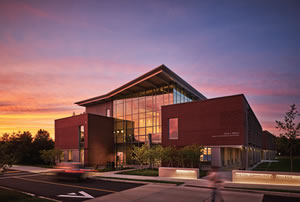
PHOTO © EDWARD CARUSO
A Zero Net Energy (ZNE) academic lab-science
building is without precedent in the Northeast, but
Bristol Community College is leading the way with the
completion of the John J. Sbrega Health & Science Building, designed
by Sasaki Associates. ZNE means the amount of energy required annually
to operate the building is equal to the energy generated onsite.
This is no easy accomplishment in New England’s climate.
Bristol has committed to reaching campus-wide carbon neutrality
by 2050. With ambitious goals in sight, Bristol and the Sasaki
team, including BR+A and Haley & Aldrich, raised the stakes on
the sustainable design of the project, aspiring to make the building
not only elegant and inviting, but also a model for energy-efficient
building on cold-climate campuses. In designing the building, the
team uncovered ways to eliminate the use of fossil fuels, increase
efficiency, and dramatically reduce demand — three critical components
of ZNE design — all without increasing the budget.
1. Eliminating the use of fossil fuels. The design team cut fossil
fuel use for heating and hot water through two strategies: an
air/ground source heat pump and a solar hot-water system.
The pump’s design permits a wider ground temperature range,
reducing the number of wells needed. Coupling the ground and
air source components allows for seasonal optimization by using
air during more temperate seasons.
2. Generating renewable energy on-site. The second component
of the design was tapping into the campus’ existing 3.2-megawatt
solar array. A standard high-performance design would have used
half the array’s power, but the ZNE design uses only 17 percent.
The building also has a rooftop PV array that offsets some of the
power usage, providing about 10 percent of anticipated demand.
3. Reducing demand. Much of the building’s energy demand was
driven by its 18 fume hoods, designed to exhaust 100 percent
outside air. Reducing the number of fume hoods was not
programmatically feasible, so a more efficient alternative was
found in filtration fume hoods. After engaging in due diligence,
including a trip to a university that had installed them, Bristol
agreed to adopt this relatively new technology. In so doing,
the school was able to achieve several other energy conservation
measures — reducing energy use by 80 percent relative to
baseline and capturing dramatic cost-savings, making the ZNE
approach feasible in the eyes of the college and the state.
4. The fume hood solution made a cascade of other conservations
possible: a 67 percent reduction in hourly air changes
and air-handling capacity; enthalpy wheel heat recovery; and
decoupling cooling/heating from ventilation by using fan coil
units for local cooling based on space occupancy.
These triggered a number of capital cost savings: a reduction
of the lab exhaust system and associated welded stainless
steel ductwork; less supply ductwork; a reduction in air handling
equipment quantity and size; and decreases in floor-to-floor
height and building envelope area.
Additional Strategies
A number of passive strategies also capture energy and
cost savings, including implementation of a high-performance
envelope by increasing R-value and decreasing thermal bridging
and air leakage; expansion of the interior temperature range to
70-76°F; leveraging of natural ventilation; reduction in glass use,
achieving a 22 percent window-to-wall ratio; self-shading; and
50 percent reduction in lighting power density.
The project is an achievement in creative thinking, stakeholder
alignment and technological execution. However, one of its most
valuable attributes is its net zero budget execution — a result of
taking a holistic approach, rather than simply combining an unrelated
menu of sustainable measures.
In an environment of fiscal constraint across the education sector
and growing pressures to reach higher sustainability benchmarks,
navigating seemingly competing forces is the linchpin of success. Analyzing
both a standard, high-performance LEED Silver building and the
ZNE approach, the team demonstrated that the ZNE approach would
not increase the budget. In a world where effects of climate change are
manifesting and all resources — including dollars — are limited, this
seems the most reasonable approach.
This article originally appeared in the issue of .