The Great Outdoors
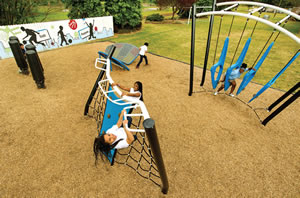
PHOTO COURTESY OF PLAYCORE
It was a telling sign when teachers, parents and students of Lockwood Elementary
School in Billings, Mont., banded together to create the school’s playground —
the ribbon-cutting was in September 2016 — there was plenty of institutional
knowledge: such stakeholders came together in 1994 for a similar effort.
Sadly, that old playground deteriorated and had to be demolished, but undaunted
stakeholders launched the new effort to envision an inclusive playground and finance
its construction. The community pitched in, the local Parent Teacher Association
raised more than $232,000 via fundraisers, in-kind donations and more; and youngsters
$60,000 from bake sales to tooth fairy money. The end result: A playground
equipped with a range of equipment, according to retired teacher and local activist
Sue Robertson and kindergarten teacher and PTA President Whitney DiFronzo.
Such sustained efforts speak to playground action elsewhere, with crowdfunding,
for example, playing a part of collaborative efforts around the country, notes
Playworld’s Ian Proud, manager of Market Research and Inclusive Play. Proud
notes other trends, including demand for materials that are “environmentally
friendly, including PVC-free” and “easy to maintain” and long lasting. He also
points out interest in playground equipment for children seven-plus years old.
On a related point another industry pro, PlayCore’s Anne-Marie Spencer, corporate
vice president of Marketing, is noting that schools today are asking for “something different” in terms of equipment
that is engaging to youngsters through their
entire time at a school. The spur: “Schools are
increasingly aware of the importance of recess
and active behavior.” Spencer continues
that it is critical that “children have activities
that are interesting at their current skill level,
as well as something to aspire to once they
have mastered the skills they are working to
develop currently.”
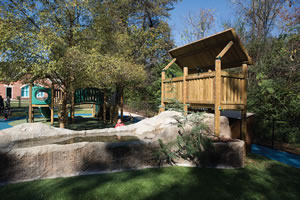
PHOTO COURTESY OF PLAYCORE
Also sharing insights about today’s
trends: Kaki Martin, partner of Klopfer Martin
Design Group, which among other related
recent and current projects, worked on the
Boston Schoolyard Initiative, a city, district
and funder initiative from 1995-2013 that created
outdoor spaces at 88 schools in Boston.
Martin notes a gathering awareness today
of options and how an outdoor area can
dovetail with what a school hopes to achieve.
It depends on the philosophy of the school,
she points out, whether there are boundaries
or intermingling between play and learning
spaces, for example. There may also be spaces
flexible enough to enable various types of activities.
There are also differences to account
for, such as constrained urban versus suburban
and rural spaces, programming generally,
and environments that are accessible to kids
whatever their physical abilities, says Martin.
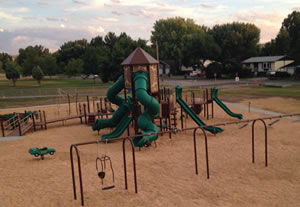
PHOTO BY MONICA SAYLER
Spencer also notes the importance of
playgrounds for kids of all abilities. And
Proud echoes the point: “The questions we
field most often are related to inclusion, and
building playgrounds that are accessible
by children of all abilities. People are often
surprised to learn an inclusive playground
doesn’t need a lot of ramps and fancy equipment.
Much can be accomplished by thoughtful
decisions about levels of challenge and
equipment location.”
Accessibility was certainly a driving
concern at Lockwood School. As Robertson
and DiFronzo report, the new playground
there is a facility “used by all children, including
those with not only physical disabilities,
but also with cognitive or emotional
disabilities.” And kids of all abilities
participated in making that facility a reality,
“The children truly wanted this playground
and were willing to work for it,” they add.
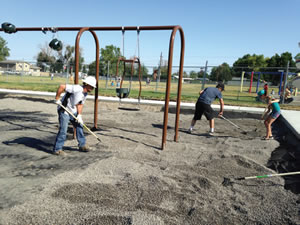
PHOTO BY SUE ROBERTSON
Martin, Spencer and Proud each point
out some other schools that have gone the
extra mile in designing and equipping outdoor
play and other spaces:
Explorations of such elements can create
attractive outdoor spaces that reflect and
propel a school’s philosophy and mission.
Finally, there’s teamwork. As Robertson
and DiFronzo put it: “Find that main group
of individuals who can build their own protocol,
work cooperatively and hit that fine
line between not micromanaging but being
supportive and respectful of each other.”
Putting such elements together can
achieve notable results. And Martin, for
one, is seeing such results at various schools.
“There’s been some amazing responses,” she
adds, “with kids thriving in outdoor spaces.”
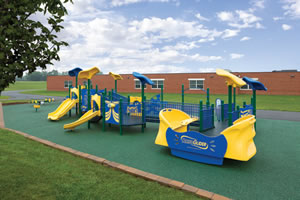
PHOTO COURTESY OF PLAYWORLD
Some thoughts about the process of creating
a playground and outdoor spaces:
- Gather your stakeholders. You’ve heard
it before, but it doesn’t make it any less
true: bring in and activate a diverse group
that includes school staff and teachers,
parents, kids, local companies and others.
- Check out learning and curriculum
tools. Anne-Marie Spencer of PlayCore
suggests her company’s Outdoor Creative
Play and Learning Kit (www.playandpark.
com/outdoor-creative-play-and-learning-box) and Me2: 7 Principles of
Inclusive Playground Design (www.inclusiveplaygrounds.org/me2/overview)
developed with Utah State University
Center for Persons with Disabilities.
- Clarify your goals and intentions, suggests
Kaki Martin of Klopfer Martin Design
Group, and also “be clear about what you can
handle” in terms of the design, construction
and maintenance of playgrounds and open
spaces. Manage expectations accordingly.
- Set a timeline. When doing so, “consider site
preparation, equipment delivery and installation,”
Playworld’s Ian Proud recommends.
- Include “what and when fundraisers
will be held,” and who will be in charge
of that step, point out Lockwood School’s
Sue Robertson and Whitney DiFronzo.
- Delegate tasks. A contractor may be installing
the playground or can lead and
assign steps to community volunteers doing
that installation.
This article originally appeared in the issue of .