The Writing on the Wall
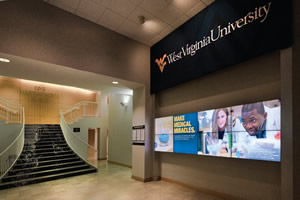
PHOTO COURTESY OF GREG ELLIS / WEST VIRGINIA UNIVERSITY
Colleges ask a lot from their signage programs. Wayfinding
may be job one, but signs, particularly digital signs,
can inform, entertain and alert as well, all while reinforcing
the campus or department brand. As the cost of digital signage goes
down, campus planners may be tempted to use them everywhere.
Three experts discuss why that may or may not be a great idea.
Spencer Graham, Manager of InfoStations,
professional technologist
West Virginia University, Morgantown, WV
Spencer Graham’s school started with just 10 digital signs but
now has 150 with plans to add more. “Static signage has its place,” he
asserts, “but with digital we can come to market so much faster.”
He’s referencing the two to four months it takes to design, approve,
print and mail a message that would sit in a traditional static
sign housing. Digital, he asserts, can be updated quickly and messages
can be customized. “The message playing at the College of Engineering
will be different than the message at the business school.”
Every sign would show generic information — weather, athletic
events, arts calendars and the like — but would loop place-specific
material as well. “It comes in handy when a guest speaker is coming
but people forgot to publicize the event,” Graham explains.
“We can get publicity up and running in a matter of minutes.”
Graham can also push emergency messages to digital signs
but will only do so sparingly. “We don’t want to be the little boy
crying ‘wolf,’” he explains, saying he wouldn’t push a traffic event
through or something that happens in the wee hours of the night.
When the call is made to push an emergency message through,
the information makes it onto the signs in under 10 seconds.
The screen will show a pulsing red background and text will give
explicit instructions on what to do next. For more information
students should rely on the campus website or check police Twitter
feeds. “We have 45,000 people on campus every day. The digital
sign, along with text and email alerts, will give basic information.”
Graham sees two areas of expansion for
digital signs on campus. The first is the Wall
of Honor. “I predicted that when we lit up our
first Wall of Honor every dean in every college
would want one.” It makes sense. Why have a
lobby or corridor filled with costly and static
brass plaques when you can honor donors
digitally? The touchscreen sign lets viewers
interact with limitless video and audio.
The other big demand is for digital
wayfinding. However, Graham cautions that
this can be a double-edged sword. “Everyone
wants wayfinding at every entrance
and elevator stop, but it takes a lot of work
to make sure the database works right,” he
says. For instance, one database may list a
room as 401, but another may call it C401. A
third may use C-401. This lack of continuity
can cause an error which reflects poorly on
the institution. “If you’re going to do this do
it right,” Graham insists. “My department
provides professional-looking deployment
but it’s up to the user to maintain the data.”
Richard Berliner, principal
Berliner Architects, Culver City, CA
“Kids today have the expectation that
information will be presented in a digital
format,” says architect Richard Berliner. To
that end he sees digital signage employed
throughout campuses for expected uses
like projecting schedules and activities and
unexpected ones like sharing student work.
“This technology lends itself to maker- or
project-based work,” he explains, saying
that it replaces the messy bulletin board.
Digital signage can also create a more
communal atmosphere. “It brings activities
off of the cell phone and on to the bigger
screen,” he says, calling it an exciting opportunity
for expression and a way to combat
isolation. “It ties into the pedagogy. Instead
of one overhead screen how about projecting
on an entire wall? It can be the best way to
foster collaboration and communication.”
Berliner acknowledges that there is a ceiling
to how far this technology goes on campus.
For instance, entire building façades can
now be billboards; but that is not appropriate
on a college campus. “Just because we can do
something doesn’t mean we should. Digital is
subservient to the overall mission.”
To keep messaging coherent, Berliner
suggests a campus gatekeeper to clear
and approve text and design. This person
should edit for message, style and font
choice to keep the college’s brand strong.
“It shouldn’t be a free-for-all!”
Tyler Gilbert, design director
Pat Miller, VP, Marketing& Project Management
Fravert Services, Birmingham, AL
When clients come to Fravert for a
signage program they are usually pretty
amped up about digital options. Tyler Gilbert
asks them to take a breath and think about
the obstacles along with the benefits. “They
cost money to maintain and the display itself
has to be more durable,” he says. Gilbert also
points to the need to have someone on campus
to manage both hardware and software.
“If you don’t have someone on site you could
get outside management — for a fee.”
While Gilbert agrees that the diminishing
cost of digital is driving interest, he stresses
that the technology is still not “cheap. A
small interactive, say a 19- or 20-inch screen,
costs about $3,500 to $4,000.” Because of this
expense, he recommends using the technology
judiciously. “Anywhere where there are
layers of information to dig into would be a
good place for an interactive, digital sign.”
He also points to the personal digital sign
already sitting in everyone’s pocket. “Information
can be easily pushed to our mobile devices,”
he says. “The physical sign is more of
a rallying point.” For that reason, he sees the
technology mostly useful in student centers or
other, non-department-specific locations.
Digital displays can also be used to set the
tone and mood of an interior. A display wall
dedicated to landscapes can help soothe and
relax occupants, for example; change the art
if you want to pump the crowd up. “These are
big-ticket items for stadiums,” says Pat Miller,
VP, Marketing & Project Management, Fravert.
Both Gilbert and Miller agree that for
basic wayfinding, traditional static signage
works best. “You want to keep people moving,
not have them congregate around a
sign,” says Miller.
This article originally appeared in the issue of .