Efficient and Prudent
- By Mark Madorsky, Ian Powell
- 07/01/17
 There is an epic shift, taking place right now, in the harnessing and production of inexpensive energy. And, it’s coming from the most abundant natural energy resource we have; the sun.
For over 50 years, the cost of photovoltaic panels (PV, or solar, panels) has made it difficult to justify in marketplaces, like the U.S., where conventionally produced electricity has been (relatively) cheap. And environmentally responsible solutions often used to mean added initial project cost.
Until recently, the marketplace for solar panels was relatively small, consisting principally of homeowners and commercial buyers. Reports in journals such as Scientific American now indicate that since 2008, the price of PV panels has dropped by more than 80 percent, and, as a result, the biggest buyer of solar panels has now become the utility companies themselves. The solar energy “math” has finally reached the point where the economics of solar are not just viable, but persuasive.
While there are many facets to sustainable projects, perhaps the most powerful and practical solution is a plan that harnesses enough on-site solar power to offset the entire annual electrical consumption of a facility; a concept referred to as net zero design.
The reduced cost to build PV panels has been the key initial ingredient in the growing number of PV projects. A more recent, and vitally important, piece of the economic puzzle is the increased acceptance by electric companies to allow the interconnection of private PV generating plants to the existing public utility system. Additionally, the willingness of utility companies to buy back excess power (“net metering”) has become a huge step in positively changing the economic analysis. It can now make great sense from a maintenance and operations standpoint to invest in solar project development.
Developing on-site solar can be broken down into four design steps. Step one is “right-sizing” the system. Every location on the planet has a unique set of coordinates that determine the available solar energy in a typical year, and the electrical demand of any building can be determined with energy modeling software. The rule of thumb for solar system sizing is to have the solar array produce approximately 60 to 70 percent of the anticipated maximum power demand for the site.
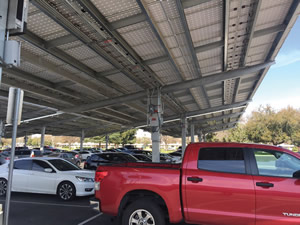
Step two is control of the PV panel type and layout. Typical options include roof mounted, ground mounted, and (parking) canopy mounted systems. Sustainability best practices are reinforced when we also teach building users about the practical energy applications taking place around them, so the PV system should, ideally, be visually accessible to building users for instructional purposes.
Step three is the all-important interconnection with the public utility. This requires detailed evaluation of the electric utility company’s interconnect agreement (for “interconnection and parallel operation of distributed power generation”). The interconnection of a PV field to a public utility system involves very stringent safety and performance standards to properly convert and send the captured solar power to the grid. Under normal conditions the PV field sends power to the building, but when there is surplus power (whenever the building power demand is less than the PV field can produce) the excess power is distributed out to the public utility grid. And this surplus power is purchased by the utility company according to the utility company’s interconnect agreement. The ability to offset operating cost, and potentially generate revenue, can yield significant maintenance and operation cost savings for a building owner.
Step four is paying for the system. There are several viable financing options including traditional design-bid-build, power purchase agreements, and for Texas municipal customers (including school districts) there is a special low interest rate lease-to-purchase agreement available for solar projects. The fiscal analysis must carefully consider both positive and negative cash flow scenarios. On the income side are the electrical power consumption and demand charges that the solar array allows the owner to avoid as well as the retail rate negotiated with the utility company for the surplus power buyback. On the expense side is the initial capital cost and routine annual maintenance (solar panels are averaging approximately 30 years of usable life).
With proper planning, a PV project can achieve near or actual net zero performance. And net metering allows for the cost-effective application of the most abundant natural resource that exists, sunlight. Creating buildings that generate as much, or more, energy than they consume, is undeniably a sustainable strategy that can be demonstrated to be both energy efficient and financially prudent.
This article originally appeared in the issue of .
About the Authors
Mark Madorsky is the president of Leaf Engineers.
Ian Powell, AIA, LEED-AP BD+C is principal-in-charge and a partner at PBK Architects, an international, award-winning architecture and engineering firm. He has extensive experience in long-range master planning, facility condition assessments, programming/pre-planning, design and construction administration of many projects.