Using Product Audits to Cut Costs
- By Michael Wilson
- 08/17/17
When we discuss financial management and budgets, school administrators know all too well what a delicate balancing act this can be. With tight budgets, many administrators find they simply must cut out or reduce such things as the cleaning of their schools. But this can be detrimental to the health of the schools’ students and staff.
However, there is another way to help reduce costs. While it does involve cutting out some items and reducing others, the end game is that it benefits the school, with little or no impact on students or staff. To do this, school administrators should conduct what is called a product audit. This can apply to many things, but a good area to start and to understand the process is with cleaning supplies.
What is a Product Audit?
But before we go there, let's define a few things. Product audits were developed by marketing firms back in the 1950s. They were most often used by manufacturers to survey consumers on how their products compared to their competitors’ products. If one manufacturer sees that a similar competitor’s product is outselling their own, the marketers would go right to the “horse’s mouth,” so to speak, and find out why consumers preferred the competitor's product to theirs.
Essentially then, a product audit is designed to help identify the high points and areas of weakness of a product. This provided an analysis and allowed the manufacturer, in this case, to make changes to their product so it can better compete.
This same process can be accomplished when it comes to school purchasing. According to David Frank, president of the American Institute for Cleaning Sciences (AICS), who has worked with school districts helping them streamline their ordering process,what so often happens in schools and school districts, is purchasing is not always centralized, and a variety of purchases are made for different products that perform the same function.
“We see this very frequently when it comes to janitorial related products – from cleaning solutions, tools and equipment, to paper products,” says Frank. “A variety of items are being purchased without analyzing just how effective or cost-effective they are compared to similar products from other brands.”
Frank suggests that school administrators ask themselves the following questions about products, especially the cleaning products they select:
- Which one is the most effective?
- Which one costs the most? The least?
- Which one is the easiest to use?
- Which one is the safest to use?
- Which one does our staff prefer to use?
If we can answer these questions, we can identify and then select only those products that are most effective, cost-effective and likely to be used. This will not only help reduce operating costs and meet budgetary constraints, but eliminate waste; take advantage of bulk purchasing that might further lower costs; free up much-needed storage space; simplify and streamline ordering; and have other benefits.
A Product Audit in Action
The following is an example of a product audit in action. A product audit team has been created and their job is to compare four different cleaning products currently in use and being purchased for the schools. To do this, we create the following graph:
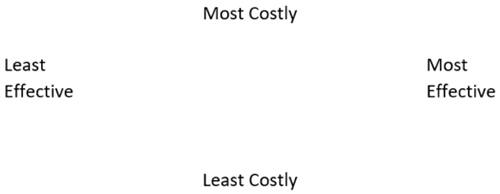
In this example, we are going to select four all-purpose cleaners and label each product A, B, C, and D. With input from the product audit team, the graph begins to look like this:
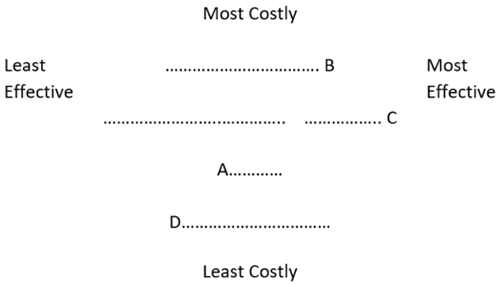
It appears product C is rated effective and right in the middle, between the most and least expensive cleaners. Additionally, we see that the two least expensive brands do not do well when it comes to effectiveness.
In this scenario, product C is likely our best choice. And by purchasing just product C, as referenced earlier, we can make bulk purchases, which might help reduce the cost of product C even more.
Making the Product Audit Easier
To help make the product review process easier and faster, school administrators can take advantage of free online software services now available. These can help them compare products as to costs and effectiveness. It can also help select green-certified products if that is a consideration.
But going online is just the beginning. School administrators should not be shy about working with janitorial distributors. When it comes to product selectin, view a distributor as a guide and a partner. Such a distributor can help school administrators through the budget maze while still keeping schools clean and healthy.
What Else Can We Learn From a Product Audit?
A product audit can look at a number of variables. Among them are the following:
- Product safety
- Ease of use
- Durability of the product (where applicable)
- Availability from suppliers
- Purchasing options
- Customer and staff satisfaction
- Environmental impact
- If rebates, special pricing is available with bulk purchases.
About the Author
Michael Wilson is vice president of Marketing for AFFLINK, a global leader in supply chain optimization, providing clients with an innovative process such as the ELEVATE™ process as well as procurement solutions to drive efficiencies in today’s leading businesses. He can be reached through his company website at www.AFFLINK.com.