A Green Place to Stay
PHOTOS © 2017 FEINKNOPF PHOTOGRAPHY / BRAD FEINKNOPF
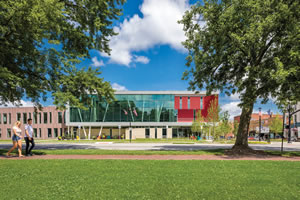
The Peter B. Lewis Gateway Center is a highly sustainable, mixed-use building that is the cornerstone of the Green Arts District, a 13-acre block that brings the arts and sciences together to create a thriving and environmentally sustainable center at the crossroads of Oberlin College and the City of Oberlin, OH.
The Hotel at Oberlin (thehotelatoberlin.com) is the major program element of the 104,000-square-foot Gateway Center. The $35 million, 70-room hotel includes a 6,500-square-foot conference center and a row of street-level retail spaces. Through a groundbreaking mix of sustainable strategies and technologies, it is on track to become LEED Platinum certified — only the fifth new hospitality project in the country to reach this achievement. As measured by Energy Use Intensity, the building will be within the top ranking of commercial structures in North America using 55 percent less energy than comparable buildings.
A History — and a Future — of Sustainability
Both Oberlin College and the City of Oberlin have demonstrated a strong commitment to sustainable design. The city and college joined together to become one of 18 Clinton Foundation Climate Positive Development Program cities (one of only three in the U.S.), committing to reducing Oberlin’s greenhouse gas emissions below zero. The campus’ Adam Joseph Lewis Center has been proclaimed as one of the most important green buildings of the 20th century by the U.S. Department of Energy. In 2006, the school signed the American College & University Presidents’ Climate Commitment and set a target climate-neutrality date of 2025.
David Orr, an Oberlin faculty member and nationally recognized thought leader in environmental studies, conceived of the Gateway Center as an opportunity for campus and community to come together and contribute to this larger conversation on climate change and responsible design practice.
Designed by Solomon Cordwell Buenz (SCB) in collaboration with Transsolar Climate Engineers, the Gateway Center is a model for high-performance building design and whole systems thinking.
Radiant heating and cooling: Rather than use a traditional air conditioning system that circulates hot or cold air to change the ambient air temperature, the hotel utilizes a radiant heating and cooling system. It is the first hotel in the country to utilize this passive system, which relies on surface temperatures within the building to heat and cool interior spaces. Each guest room contains a radiant ceiling panel and a ceiling fan, which helps increase the cooling performance of the system by moving air across the panel.
Geothermal: The radiant heating and cooling system is supported by a geothermal field composed of 48 405-foot-deep wells. Loop water is circulated through the ground, carrying heat away from the building during warm periods and supplying heat to the building during cool periods, and into the building to water-to-water heat pumps. The water-to-water heat pumps have the ability to simultaneously provide heating and cooling water without using any extra energy by capturing heat from areas that need cooling and circulating it to spaces needing heat.
Natural ventilation: The public areas of the building, including the lobby, restaurant and event spaces, are naturally ventilated through a large, two-story atrium. An automated system opens windows on the ground level to intake fresh air, while windows at the top of the atrium are opened to release warm air, creating a natural stack effect.
And more: Photovoltaic panels supplement power production for the hotel. Oberlin’s on-campus 2.27-MW solar array covers 10 acres, and can generate approximately 3,000,000 kWh of electricity annually. Rainwater is harvested and used for landscape irrigation, while on-site bio-retention basins slowly filter stormwater. A high-performance façade and exterior automatic solar shading devices reduce heat gain.
Local Ties
The interior design for the project uses natural, salvaged or recycled materials and sourced 50 percent of building materials from within 500 miles from Oberlin. Whenever possible, materials with low volatile organic compounds (VOCs) were specified to minimize off-gassing and improve interior air quality.
As part of the Green Arts District, art was obviously to play a major role in the project’s design. Ohio native Maya Lin, designer of the Vietnam Veterans Memorial in Washington, DC, created a three-part installation called “An Ecological Primer: A landscape in 3 parts” that spans the hotel’s lobby and grounds.
Guests Go Green, Too
The Hotel at Oberlin takes a proactive approach to educating guests on how they can impact building performance and participate in conservation measures. Guest rooms are fitted with indicator lights that show when outdoor conditions are suitable for opening the windows. When the windows are open, sensors automatically shut off the radiant panels and ventilation system. Educational signage and an information kiosk that displays energy consumption data are presented in an easy-to-understand manner, making sustainability education part of the guest experience.
A Step Forward
It makes perfect sense that this highly innovative facility would take shape at Oberlin. The Peter B. Lewis Gateway Center and Hotel at Oberlin represent a step forward on the continuum of sustainable design that has helped, and continues, to shape and define the college and city.
This article originally appeared in the issue of .
About the Author
Jim Curtin, AIA, is a principal at Solomon Cordwell Buenz (SCB, www.scb.com).