The Key to Security
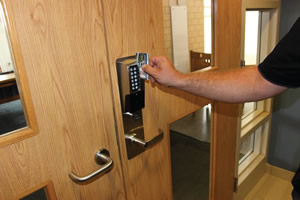
PHOTO COURTESY OF ASSA ABLOY
As U.S. citizens wrestle with yet another mass shooting, security is on everyone’s mind. Of course, the topic never really left the forefront for university administrators and facility managers. Charged with protecting population sizes and demographics that rival small cities, they know the importance of their task.
They also know that a school’s security can make or break a potential student’s college choice. To wit, U.S. News and World Report publishes “10 Questions Every Parent, Student Should Ask About Campus Safety.” BestColleges.com has gone so far as to rank schools by their safety plans and procedures. “Students and their parents are listing safety along with class size, location, cost and ranking when it comes to important factors when choosing a college,” they write.
CPTED Primer and Progress Report
Crime Prevention Through Environmental Design or CPTED, has been around for, “at least 40 years,” according to Dan Alvarez, president, Alvarez and Associates — CPTED, Inc. The concept, widely accepted in Canada and the European Union, is relatively new here but has gained more acceptance in the last decade or so.
“The goal of CPTED is the reduction of opportunities for crime to occur,” writes Robert Gardner, CCP in an article for Security Management magazine. “This reduction is achieved by employing physical design features that discourage crime, while at the same time encouraging legitimate use of the environment.
CPTED also makes possible designs that offer protection without resorting to the prison-camp approach to security.”
A CPTED approach is much friendlier. Made up of several factors which include better lighting, well-tended landscaping and open design, the concept creates opportunities for informal surveillance where visual obstacles are minimized and places of concealment are eliminated. Accomplishing this can be as easy as boosting lighting levels, pruning overgrown shrubbery to choosing fencing over brick walls.
The overall effect fosters a sense of pride and ownership over public, semi-public and private spaces. “It is not enough for a person simply to be able to defend his environment, he must also want to defend it,” writes Gardner. “That ‘want’ results from territorial feelings of pride and ownership.”
The concept includes harder fixes as well such as formal surveillance, via camera or organized security patrols. “With cameras your field of vision can be multiplied 50 times,” says Alvarez.
CPTED may have come a long way but Alvarez thinks there’s still work to be done. “College risk-management groups and campus police are aware of CPTED but not knowledgeable on how it would work on their campus,” he muses. “Even the security chief often does not understand the core principals.”
Locking Down Locks
A locked door is an important part of any security plan and new locking strategies are rising to the occasion. The old metal key is giving way to a variety of electronic access control options that operate with a card. The device not only opens the door but tracks who used the card and when it was used.
“They can restrict access based on time or location and if a card is lost you can just deactivate it,” explains Daniel Stewart, business development manager, BEST Access Solutions, a dormakaba company.
Hard-wired access control options are often a security manager’s first choice. The technology is tried and true, around long enough for maintenance personnel to be familiar with it and it provides instant feedback notification and control. However, it costs about, “$3,000 to $5,000 per door,” according to Stewart, putting it out of reach for the thousands of doors that might be on any given campus.
Because of the price, hard-wired locks work best for perimeter control. For the rest a variety of electronic locks, wireless, WiFi-enabled and even solar-powered options are available. A wireless lock runs about $1,000 per door, according to Stewart. They still record who entered and when, but not in real time.
“More schools are adopting this kind of access control deeper into the campus,” reports Jeremy Saline, director of business development — universities, ASSA ABLOY. “Classrooms, locker rooms, labs, housing, common areas and more benefit.”
Maintenance means changing batteries for wireless locks and keeping the door in good condition. Alvarez recommends checking all doors quarterly and suggests schools invest in service agreements or at least, “IT departments and maintenance staff who understand the capabilities of the product and the possible ways it can malfunction.”
As for the future of locks, Saline sees some schools moving towards “mobile credentials, solar power and biometrics.” Stewart predicts the credentials will continue to move from a card with a magnetic stripe to smarter chipped cards. After that, credentials may move to your mobile phone. “You’re significantly less likely to lose your phone than your card,” he says.
But does this mean that the good old, inexpensive, metal key will disappear forever? “No! 100 percent of colleges are still using keys,” says Stewart. “Computers can stop working, batteries can fail. You’ll always have a need for a mechanical way to get through a door.”
This article originally appeared in the issue of .