Columbia College Chicago Granted Building Permit for Student Center

Columbia College Chicago in Chicago, IL, recently was granted a building permit, and announced it is preparing to begin work on a new student center in Chicago’s South Loop neighborhood. The 114,000-square-foot facility, designed by Gensler, will fill a vacant lot.

The design for the new student center is centered on flexibility, including maker spaces, lofts, labs, and a fitness center and dining commons. The facility will feature a glass façade that allows occupants to look out and interact with the community surrounding it.
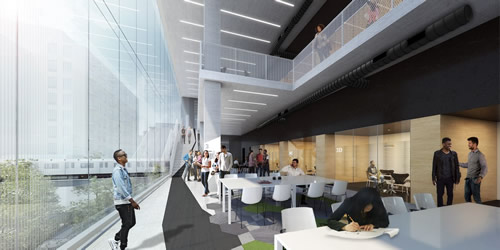
Columbia College Chicago Granted Building Permit for Student Center

With a groundbreaking held this past November, the center is targeting a completion date of early 2019.

Featured

  • Spaces4Learning Trends & Predictions for Educational Facilities in 2026: Part I

    We asked, you answered, and the results are in! Last year, we put out a call for submissions to collect our readership’s opinion on trends and predictions for K–12 and higher education facilities in 2026.

  • Houston K–12 District Opens New Elementary School

    The Lamar Consolidated Independent School District (Lamar CISD) recently announced the completion of a new elementary school in a western suburb of Houston, Texas, according to a news release. Haygood Elementary School measures in at 110,000 square feet, has the capacity for 854 students, and is the first of three new schools scheduled to be built in the Cross Creek West community.

  • University of Arizona Approves New Residence Hall

    The Arizona Board of Regents recently approved plans for a new residence hall at the University of Arizona in Tucson, Ariz., according to a news release. The new facility is scheduled to open in fall 2028 and have the capacity for more than 1,200 students, enforcing a new university expectation that all first-year students live on campus.

  • Pitzer College

    Designing for Change in Higher Ed Learning Environments

    Higher education will continue to evolve, and learning environments must evolve with it. By prioritizing adaptable infrastructure, thoughtful reuse, strong energy performance, and wellness-centered design, campuses can create spaces that support learning today while remaining flexible for the future.