Transforming Walls into Versatile Surfaces
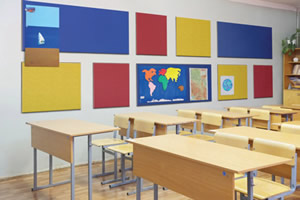
Fabric walls from Fabricmate Systems help personalize classroom spaces and provide better acoustics.
A growing number of schools are transforming their classroom, lecture hall, auditorium, and hallway walls into vibrant, multipurpose, functional surfaces by installing unique fabric wall covering systems.
By adding these wall systems, they are not only personalizing and enlivening drab spaces, but also improving the learning environment while eliminating a major source of routine maintenance and re-painting.
“Teachers like to display student work as inspiration, and staple student work or study aids to the classroom walls from floor to ceiling, which can require frequent wall touch up,” says Brad Heinecke, a maintenance technician at Orange Lutheran High School.
When staples, tacks or tape are used as a fastening method this inevitably takes a toll on painted walls. This necessitated repainting each classroom every two to three years. To do such work including touch-up in this and other areas, the school once employed a full-time painter.
The high school opted to install fabric wall coverings from Fabricmate Systems, a global supplier of wall surface solutions.
With the help of one other person, Heinecke installed the system. “Once you get the process down, it goes up pretty quick,” he says.
Heinecke says the fabric covered wall system is holding up extremely well in the classrooms.
“Everyone is seeing how great the wall coverings are, and are requesting installation this summer,” says Heinecke.
Bare painted walls are an acoustics nightmare.
To counter this, the fabric wall covering’s backing absorbs sound rather than reflecting it. This reduces echoes and reverberations and makes it easier to hear and understand speech or audio with greater clarity.
When school administrators want to refresh the walls or even change the colors the fabric can be replaced by school maintenance personnel and the only cost is for the new fabric itself. The backing and track system do not typically need to be replaced.
www.fabricmate.com
This article originally appeared in the School Planning & Management May 2018 issue of Spaces4Learning.