From Teacher to Student-Centric Learning
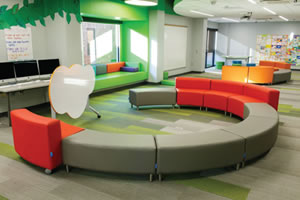
Wallace Elementary School in Johnston, Iowa, integrated NorvaNivel’s furniture collections to help their classrooms move from a teacher-centric to a learner-centric pedagogy.
With the goal to move from teacher-centric to learner-centric pedagogy, Wallace Elementary School in Johnston, Iowa, home to nearly 600 students in grades K-5, created new classrooms and breakout spaces to support its learning community. After a long consideration of suitable furniture for the spaces, school decision makers discovered NorvaNivel and knew they had found a solution. The new learning spaces have empowered students with choice and educators with functionality, allowing them to reconfigure their spaces for different learning activities within seconds.
Despite knowing what they wanted to achieve in the learning spaces, the school felt challenged in realizing its vision for agile learning spaces. Rearranging the existing furniture into a more flexible layout was not delivering on the requirements. Additional furniture they purchased overwhelmed the space and wasn’t comfortable for students.
NorvaNivel has years of experience creating highly-adaptable learning spaces to facilitate contemporary pedagogy. With the goal to create flexible classrooms and breakout areas, school decision-makers saw that NorvaNivel’s furniture could deliver against key requirements.
NorvaNivel used a collection of key products to meet the school’s challenges: The GENGA collection of foam blocks to encourage communication, creativity, and critical thinking; the CONCLAVE Collection of group seating; the STEAMSPACE T-Table collection of collaborative desks; the WORKPAD Caddy a storable and moveable seating solution; and the SUNSHINEONACLOUDYDAY Foldable Table for a dynamic collaborative work and presentation space.
With a choice of flexible seating and work areas, students are empowered to create their own places to learn. Having ownership over their space has made them more comfortable and more receptive to learning. Contemporary pedagogies require flexible learning environments. With their new learning spaces, Wallace Elementary can adapt to whatever the curriculum requires.
www.norvanivel.com
This article originally appeared in the School Planning & Management January/February 2019 issue of Spaces4Learning.