University of California, Berkeley: David Blackwell Hall
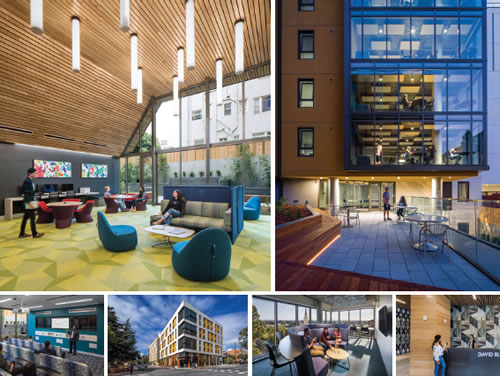
PHOTOS © DAVID WAKELY
David Blackwell Hall is a new residence hall at the University of California, Berkeley. Developed through a public-private partnership (P3) with American Campus Communities and designed by Solomon Cordwell Buenz, the 184,000-square-foot mixed-use project combines urban planning principles, innovative sustainable systems, and campus design sensibilities to create a unique new addition to both the UC Berkeley campus and the South Berkeley community.
The building provides 776 beds of first-year undergraduate housing organized into a series of pods made up of double occupancy rooms and gender-inclusive bathrooms. The hall is part of the university’s plan to add 7,500 beds on campus within the next decade.
Student amenities including an academic success center, fitness center, and entry lounge along with 7,000 square feet of ground-floor retail. The building also provides a new home for Stiles Hall, a mission-driven community service organization that has engaged UC Berkeley students for over 125 years.
The project is projected to reach LEED Gold through a variety of sustainable features and systems focused on reducing energy consumption. Air conditioning is provided only in shared, communal spaces; residential units are served by low velocity, tempered ventilation, which is augmented by operable windows and supplemented by individually controlled electric radiant modules over the windows. Responsive lighting throughout adjusts in brightness according to the amount of natural light infiltrating the building at different points in the day.
Blackwell Hall consumes 44 percent less energy than required by the stringent local code, achieving an energy use intensity of 36 kBtu/square foot. It meets the ambitious energy targets set by the American Institute of Architects’ 2030 Challenge, performing 70 percent better than similar buildings in the same climate.
This article originally appeared in the College Planning & Management January/February 2019 issue of Spaces4Learning.