Student Union Renovation Begins at UMass Amherst

The Student Union building on the campus of the University of Massachusetts, Amherst, closed for renovation in January. The renovation has been designed by Shepley Bulfinch.

When the building reopens for the fall 2020 semester, most interior walls will have been removed and the interior generally repartitioned. The ballroom, now on the main floor, will be one floor higher and feature exposed columns and trusses.
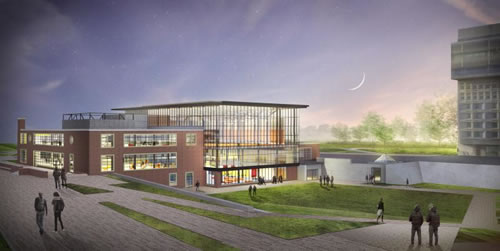
UMASS Student Union

Students will find an active “Main Street” style promenade with concentrated retail, student services, and dining options, and there will be a new entry and outdoor plaza with a streamlined connection to the Lincoln Campus Center. Other renovations include:

  • A consolidated media center serving the Daily Collegian, UVC-TV19, and WMUA that is positioned so activity is visible from the “Main Street.”
  • Expanded student business space.
  • New meeting, activity, and assembly space.
  • Cape Cod Lounge will be repurposed into new, divisible, multipurpose areas for medium-sized assembly and function space.
  • Mechanical and electrical systems will be updated.

Featured

  • Abstract tech network data connections with orange, blue glowing dots, lines

    3 Trends for Higher Education to Stay Ahead of in 2026

    As universities enter the new year, the question is no longer whether digital transformation is necessary, but how quickly institutions can convert technological potential into strategic advantage.

  • Photo credit: Elkus Manfredi Architects

    University of Virginia Selects Design-Build Team for New Residential Complex

    The University of Virginia in Charlottesville, Va., recently announced that it has selected a design-build team for a new upper-class residential development on campus, according to a news release. Capstone Development Partners—in partnership with Elkus Manfredi Architects and the Hoar Construction/Hourigan construction team—will move forward with the three-building, 310,000-square-foot housing facility.

  • Pitzer College

    Designing for Change in Higher Ed Learning Environments

    Higher education will continue to evolve, and learning environments must evolve with it. By prioritizing adaptable infrastructure, thoughtful reuse, strong energy performance, and wellness-centered design, campuses can create spaces that support learning today while remaining flexible for the future.

  • Different Starting Points, Same End Goal

    Higher education campuses can enhance student experience by implementing mobile credentials to streamline building access, on-campus payments, and access to other amenities. This enables students to connect to their campuses through the technology they use most: their mobile devices.