New Health Sciences Building for the University of Colorado

The University of Colorado has broken ground on the Anschutz Health Sciences Building at the University of Colorado (CU) Anschutz Medical Campus in Aurora. The seven-story, 390,914-square-foot interdisciplinary building will house faculty leaders in mental and behavioral health including the CU Department of Psychiatry, as well as the Colorado Center for Personalized Medicine, the Colorado Clinical and Translational Sciences Institute, classrooms, exhibit space, and more.
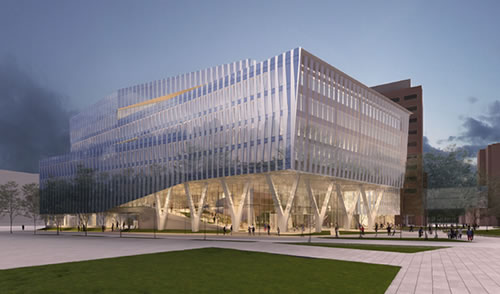
University of Colorado Health & Sciences

Key design elements in the building include:

  • facilities for computational research and clinical trials, a simulation education hub, mental health clinics, a data center, faculty offices, and other educational spaces;
  • integration of exterior and interiors spaces with ledges and terraces offering spaces for collaboration and access to the outdoors;
  • occupant wellness and biophilia strategies; and
  • a sky-lit atrium serving as a central gathering space.

Designed by ZGF architects in partnership with Anderson Mason Dale, the project is targeting LEED Gold v4 certification and is scheduled for completion in 2021.

Featured

  • Virginia Tech Tops Out New College of Engineering Building

    Virginia Tech in Blacksburg, Va., recently celebrated the topping out of Mitchell Hall, which will soon stand as the largest College of Engineering building on campus, according to a news release. The university partnered with Skanska on the 285,500-square-foot facility, which has an expected completion date of winter 2028.

  • Montclair State University Starts Construction on $120M STEM Building

    Montclair State University in Montclair, N.J., recently broke ground on a new $120-million Interdisciplinary Science Building, according to university news. The university partnered with HoK Architects for the project’s design, and it’s scheduled to open in time for the 2028–29 academic year.

  • Rethinking K-12 Schools as a Continuous Learning Experience

    Most students move through three or more separate facilities during their K-12 journey, yet the built environments they encounter at each stage have traditionally been designed in isolation, with little continuity in spatial language, learning philosophy, or physical resources. Each new school is a reset with different layouts, learning models, expectations, and ways of moving through a building. The next generation of school design is making the case that the first day of kindergarten and the last day of high school can and should feel connected through common support systems and infrastructure in the physical environment.

  • Minnesota District Converts Middle School into Community Hub

    White Bear Lake Area Schools in White Bear Lake, Minn., recently announced the end of a major renovation project that converted a former middle school into a new centralized district and community hub, according to a news release.