Keeping Schools Healthy Starts Before the Kids Get to School
 Studies indicate that as much as 80 percent of the soil and debris in a facility is essentially walked-in the front door. This is because moisture, soil, grit, and sand collect on shoe bottoms. It is also why ISSA, the worldwide cleaning association, the U.S. Green Building Council, and other organizations, encourage or require the use of floor mats installed at all building entries. Mats help keep soil outside and prevent it from coming inside.
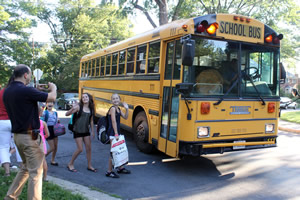
However, if our goal is to keep schools clean and healthy, we may want to go beyond just floor mats. What administrators also need to consider are the buses used to transport students to and from schools every day. The American School Bus Council estimates about 480,000 school buses are carrying 25 million American school children each day. It’s the largest form of public transportation in the country.
But what if those school buses are contaminated with germs, such as Norovirus–which can live on surfaces for up to two weeks–Scabies, HIV, hepatitis, MRSA, or Staph, just to name a few. If students touch those surfaces, the pathogens on those surfaces may collect on their hands and then be transferred to their mouths, nose, or eyes, doorknobs, desks, ledges, restroom fixtures, and just about any “touchable” surface in the school.
Further, the reverse can happen. Once home, those same pathogens on hands can be transferred to scores of surfaces throughout the house.
According to the National Education Association (NEA), this can and has proven to be a serious problem. The organization reports, “School buses are mobile environments that are prone to the spread of infectious diseases such as colds and the flu. In addition to the number of students who may introduce bacteria and viruses when they board the bus, surfaces such as the seatbacks and handrails can also contribute to the further spread of germs. Keeping these areas clean can help prevent germs and the spread of disease.”
The question then arises, why isn’t more time spent on keeping school buses clean and healthy? After all, school districts throughout the country have invested considerable sums in both time and energy to help keep schools clean. Why not the buses that carry students to school?
Some of the answers to these questions are the following:
- Administrators in some school districts may not be aware of this problem.
- Many school districts hire outside contractors to bus students; they believe the contractor is responsible for keeping the buses healthy.
- Buses can take a long time to clean.
While all of these answers carry some weight, it is the last one that is often the core issue. If manually cleaned, areas in the bus that must be wiped down include seats/seat backs, railings, doors and window areas, and floors swept, and all too often, also mopped.* Further, this work should be performed daily or a regular cleaning schedule should be established.
Compounding the problem, many of these areas in the bus must be cleaned twice. We must always remember when manually cleaning surfaces that before we can disinfect a surface, it must be first cleaned with an all-purpose cleaner. Then it is cleaned again with a disinfectant. It’s a two-step process.
Most likely, each bus will take at least 30 minutes to clean, if not longer. Because time is money when it comes to cleaning, this could cost districts a considerable sum if they operate many buses and must pay their own staff to handle bus cleaning. The outside contractor is reluctant to detail-clean their buses because it can impact profits.
So what options do we have?
One option is to electronically mist the buses. While there are different types of systems available, they usually fall into a category known as electrochemically activated cleaning and disinfecting solutions. A mist is applied to all the bus surfaces mentioned earlier. The big plusses are that this is a very environmentally friendly way to kill pathogens and has proven effective at killing a wide range of pathogens. The big negative is that with most systems, surfaces are not actually cleaned, and this can interfere with the disinfecting solution’s effectiveness. Compare this to using a hand sanitizer. The sanitizer will kill surface level pathogens on the hand, but not necessarily remove soil or dead organisms on the hands.
Another option is to spray-and-vac the buses. Developed for restroom cleaning, this form of cleaning, often called no-touch cleaning, has proven both fast and effective in a variety of cleaning situations. Using a machine, the operator applies cleaning solution to all surfaces of the bus. These same areas are then pressure rinsed with water. Moisture and soils are then vacuumed up. Further, the two-step disinfecting process mentioned earlier is not always necessary. Studies indicate that pathogens are often removed in the cleaning process. **
Preventive Medicine
We should consider any cleaning system, process, product, or procedure that keeps soils and pathogens from entering a school as a form of preventive medicine. The goal of preventive medicine is to protect health and prevent disease, and one way we need to start doing this is by keeping school buses clean and healthy.
*Several studies now report that the mopping process spread soils and pathogens. Because of this, medical facilities and many schools are now cleaning floors using alternative floor cleaning methods.
**If a disinfectant is recommended or required, it should be used.
This article originally appeared in the School Planning & Management March 2019 issue of Spaces4Learning.