College of the Atlantic Plans New $13M Academic Building

This spring, groundbreaking will take place on the campus of the College of the Atlantic in Bar Harbor, ME, on a new $13-million, energy-efficient Center for Human Ecology building that will house science laboratories, lecture halls, faculty offices, art and design studios, and a teaching greenhouse.
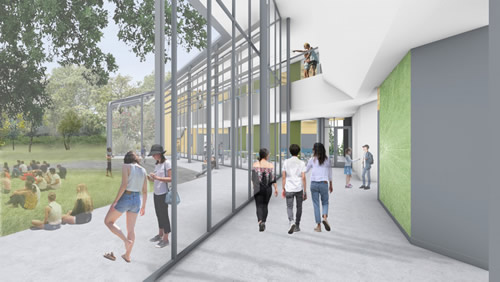
College of the Atlantic

The two-story, 29,000-square-foot building will be built to exacting energy standards, reducing energy usage by 80 percent compared to a similar building with more traditional construction designs and materials.

The architects for the project are Susan T. Rodriguez of New York City and GO Logic of Belfast, Maine. E.L. Shea, Inc. of Ellsworth is expected to lead construction of the building, which is expected to be completed by September 2020.

Featured

  • concentric silhouettes of a human head

    How Physical Space Shapes the Mind: Designing for Better Learning Outcomes

    Research in environmental psychology and neuroscience increasingly suggests that the way a room is designed can influence memory, focus, or even a student's sense of belonging.

  • El Paso District Breaks Ground on New Elementary School

    The Canutillo Independent School District in El Paso, Texas, recently announced that construction has begun on a 119,000-square-foot elementary school, according to a news release. The district partnered with Pfluger Architects, Carl Daniel Architects, and LDCM Solutions on the new Davenport Elementary School, which has an expected completion date of 2027.

  • University of Kentucky Receives $150M Gift Toward New Arts District

    The University of Kentucky’s Board of Trustees recently received a $150-million gift from The Bill Gatton Foundation, according to a university news release, to build a new arts district on the campus in Lexington, Ky. The new district will feature a new College of Fine Arts building and a multi-hundred-seat theater, among other amenities.

  • Spaces4Learning Trends & Predictions for Educational Facilities in 2026: Part II

    As education leaders look toward 2026, the design of K–12 and higher education facilities is being reshaped by powerful, converging forces. Survey respondents point to the rapid growth of Career and Technical Education, deeper alignment with workforce and industry needs, and the accelerating influence of AI and emerging technologies.

Digital Edition