FAMU Breaks Ground on New Residence Hall

TALLAHASSEE, FL – Florida A&M University (FAMU) recently broke ground for a 700-bed residence hall that is scheduled to open in August 2020.
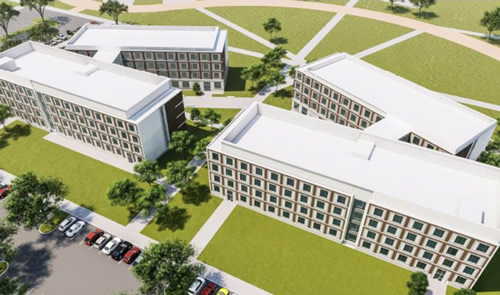
FAMU New Residence Hall

The housing project is expected to have two four-story H-shaped residential structures amounting to 183,496 square feet, with 366 units, 700 student beds, and shared amenity spaces including kitchens, laundry, and study areas, as well as lounge and game rooms. Due to three residence hall closures that will take place next year, the new living quarters will replace beds for current and future students.

FAMU President Larry Robinson says the $125 million-federal loan to address student housing projects will allow construction on the new residence hall to get underway this month.

Featured

  • Vanderbilt to Partner with ABM for Campus Preservation and Modernization

    Vanderbilt University recently announced that it has selected ABM Performance Solutions for a preservation and modernization project at its New York City campus, according to a news release. ABM will deliver its end-to-end ABM Performance Solutions (APS) model to manage critical operations during renovation and maintenance.

  • NWEA Report Recommends K–12 Natural Disaster Recovery Strategies

    The Northwest Evaluation Association (NWEA), a K–12 assessment and research organization, recently announced the release of a new playbook for schools and communities recovering from extreme weather events, according to a news release.

  • Stanford Completes Construction on Graduate School of Education Facility

    Stanford University in Stanford, Calif., recently announced the end of construction on a new home for its Graduate School of Education, according to a news release. The university partnered with McCarthy Building Companies on the 160,000-square-foot project, which involved two major renovations and one new construction effort.

  • Spaces4Learning Trends & Predictions for Educational Facilities in 2026: Part II

    As education leaders look toward 2026, the design of K–12 and higher education facilities is being reshaped by powerful, converging forces. Survey respondents point to the rapid growth of Career and Technical Education, deeper alignment with workforce and industry needs, and the accelerating influence of AI and emerging technologies.