IUPUI to Construct New Classroom Building

INDIANAPOLIS, IN – Indiana University–Purdue University Indianapolis (IUPUI) will soon begin construction on its newest building, the Multidisciplinary Research and Classroom Building (MRCB). The Indiana University Board of Trustees approved the architectural design for the building, to be located at the eastern edge of campus, in October 2018.
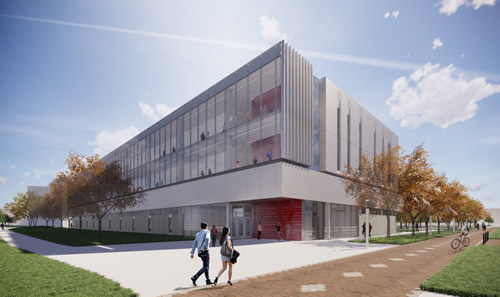
IUPUI classroom building

The MRCB is an adaptable facility that will meet evolving teaching and research needs for programs in the School of Science, the School of Engineering and Technology, and the School of Informatics and Computing. It will include a state-of-the-art interdisciplinary research and lab space, a cleanroom environment, a makerspace, and modernized classrooms and collaborative learning spaces.

The first floor will be home to three major classrooms, as well as an informal student lounge and seating area. The classrooms include a 215-seat tiered lecture hall, an 81-seat active learning space with movable chairs and tables, and a 125-seat active learning space where the faculty member is in the middle. Shaped like a football, that space has two tiers of seats that swivel to encourage collaboration. The second and third floors will contain engineering and science labs, as well as more classrooms.

Construction is expected to finish in August 2020.

Featured

  • Designing the Bridge Between Inclusivity and Independence in K–12 Schools

    Fostering independence is fundamental to learning and development for K–12 students. It offers many proven benefits, such as enhanced confidence, problem-solving, decision-making, and social skills. However, this foundational objective loses its impact if it’s not accessible and adaptable to all students. Inclusivity plays a critical role in cultivating independence and healthy autonomy for students, fostering positive student learning outcomes by uniting pedagogy with the physical learning environment.

  • Rethinking K-12 Schools as a Continuous Learning Experience

    Most students move through three or more separate facilities during their K-12 journey, yet the built environments they encounter at each stage have traditionally been designed in isolation, with little continuity in spatial language, learning philosophy, or physical resources. Each new school is a reset with different layouts, learning models, expectations, and ways of moving through a building. The next generation of school design is making the case that the first day of kindergarten and the last day of high school can and should feel connected through common support systems and infrastructure in the physical environment.

  • Minnesota District Converts Middle School into Community Hub

    White Bear Lake Area Schools in White Bear Lake, Minn., recently announced the end of a major renovation project that converted a former middle school into a new centralized district and community hub, according to a news release.

  • ed tech conference calendar

    Upcoming Awards, Events & Webinars